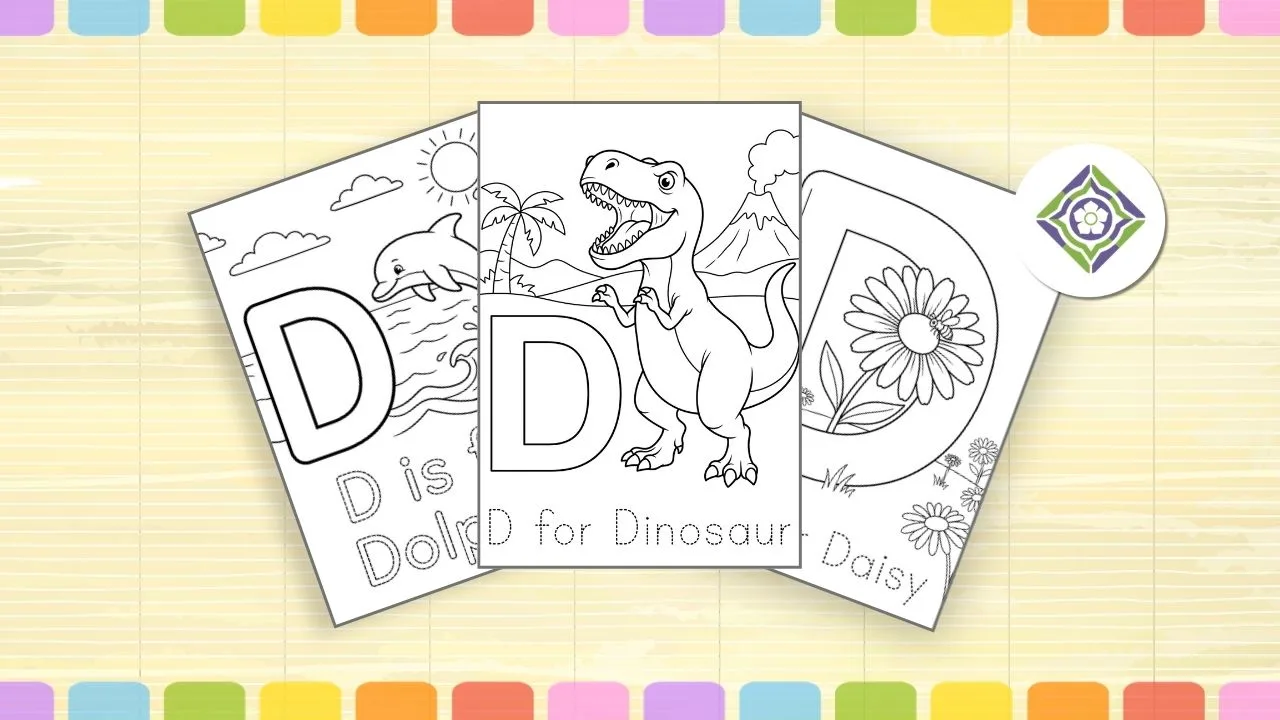
The letter D has a quiet confidence that the more dramatic letters of the alphabet lack. It does not shout. It curves. That single clean arc attached to a solid vertical line produces one of the most recognisable letter shapes in the alphabet, and children learn it quickly precisely because its shape is so distinctive. D is for dog. D is for duck. D is for dinosaur, dolphin, daisy, dragon and donut. Almost every word a young child loves begins with a letter D.
This collection has 30 free letter D coloring pages covering simple designs for toddlers, phonics pages for preschoolers, tracing and labeling pages for kindergarten, bubble letter and decorative designs for older children, and detailed floral, mandala and zentangle pages for adult colorists. All pages download as free PDFs and print on US Letter and A4 paper without sign-up.

Toddler letter D coloring pages simple
Printable Letter D Coloring Pages

printable letter d coloring pages tracing worksheet

preschool letter d coloring pages duck

lowercase letter d coloring pages

Letter D Words Coloring Pages Word Web
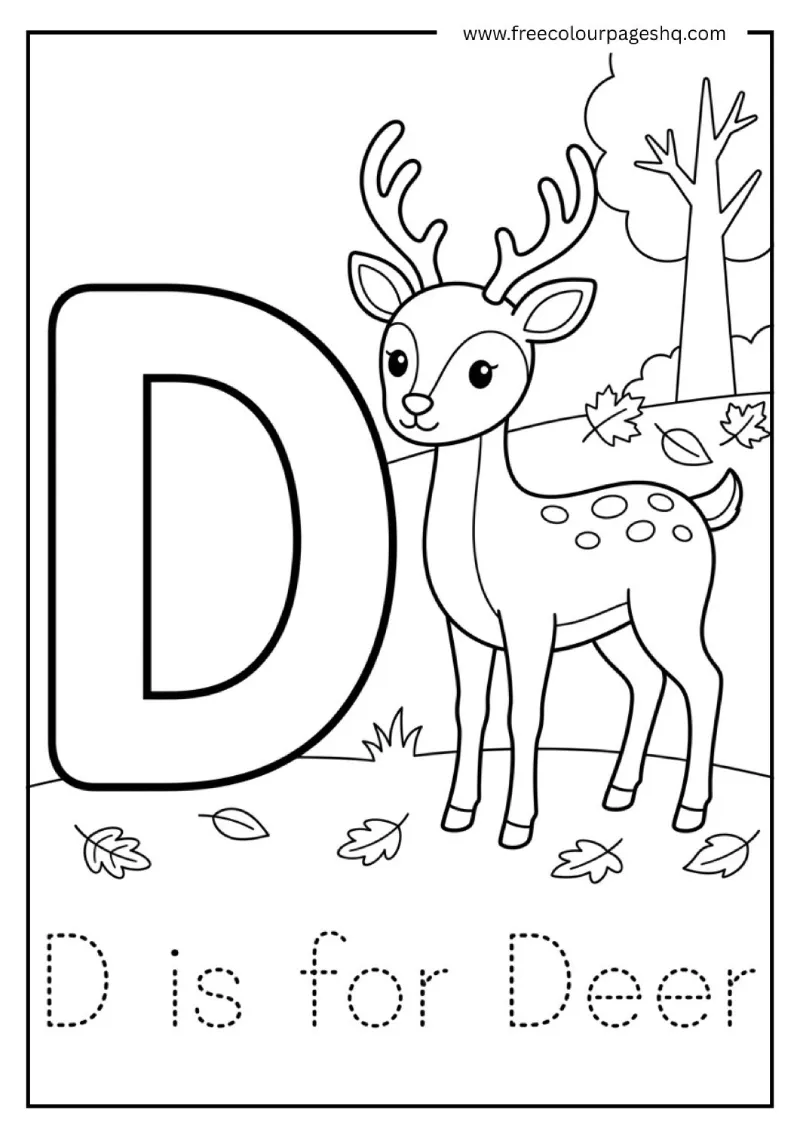
letter d coloring sheet deer
Letter D Coloring Pages
Letter D Coloring Pages Printable

Letter D Coloring Pages for Preschoolers Dragon

letter d coloring pages for kids daisy

Letter D Coloring Pages Christmas

Letter D Adult Coloring Pages Stained Glass
Free Printable Letter D Coloring Pages

Free printable letter D coloring pages complete reference

fancy letter d coloring pages decorative

d for dinosaur coloring page
coloring pages with the letter D, uppercase and lowercase

capital letter d coloring pages block

alphabet letter d coloring pages dolphin
Why Letter D Coloring Pages Work for Early Learning
The letter D appears frequently in early childhood vocabulary precisely because so many common and beloved nouns begin with it. Dog, duck, dinosaur, dolphin, drum, donut, daisy, dragon, deer and door are all high-frequency words in children’s picture books, conversation and play. This means that letter D vocabulary encounters happen naturally and constantly outside the classroom, which reinforces phonics learning in a way that less common letter sounds cannot.
The letter D produces one consistent sound in English, the voiced alveolar stop represented in linguistic notation as the /d/ sound. Unlike the letter C, which produces different sounds in different words, the letter D is phonetically predictable. Children who learn the D sound through letter D coloring pages will find that this phonics knowledge applies consistently across every D word they encounter, which builds confidence faster than learning letters with multiple sound patterns.
The shape of the letter D also has specific value in handwriting development. Learning to form the uppercase D, a vertical stroke on the left and a curved stroke on the right meeting cleanly at top and bottom, builds the motor memory children will use later when forming the letters B, P and R, all of which begin with the same vertical stroke. The lowercase d uses the same circular stroke as the letters a, g and q, making it a foundational form for a significant portion of the alphabet.
Simple Letter D Coloring Pages for Toddlers
Toddler letter d coloring pages need to prioritise simplicity above everything else. Very large outlines, minimal interior detail and a single immediately recognisable object beside the letter. The coloring session at this age is primarily about the vocabulary encounter, not the artistic result.
A large letter D with a single duck beside it, or a dog, or a dinosaur, gives a two or three year old everything they need. The object beside the letter should be something the child encounters in daily life, in books, in the garden, in conversation. When a child who has coloured a D is for Duck page sees a duck in a park three days later, the phonics connection reinforces itself automatically.
Letter d coloring pages for toddlers should avoid small enclosed spaces, fine detail and complex backgrounds. A large D, one large illustration and generous white space are the three elements of a successful toddler letter page.
Preschool Letter D Coloring Pages
Preschool letter d coloring pages open up considerably in terms of design variety and educational complexity. Children aged three to five have developing fine motor skills, growing vocabulary and genuine enthusiasm for learning letter names and sounds.
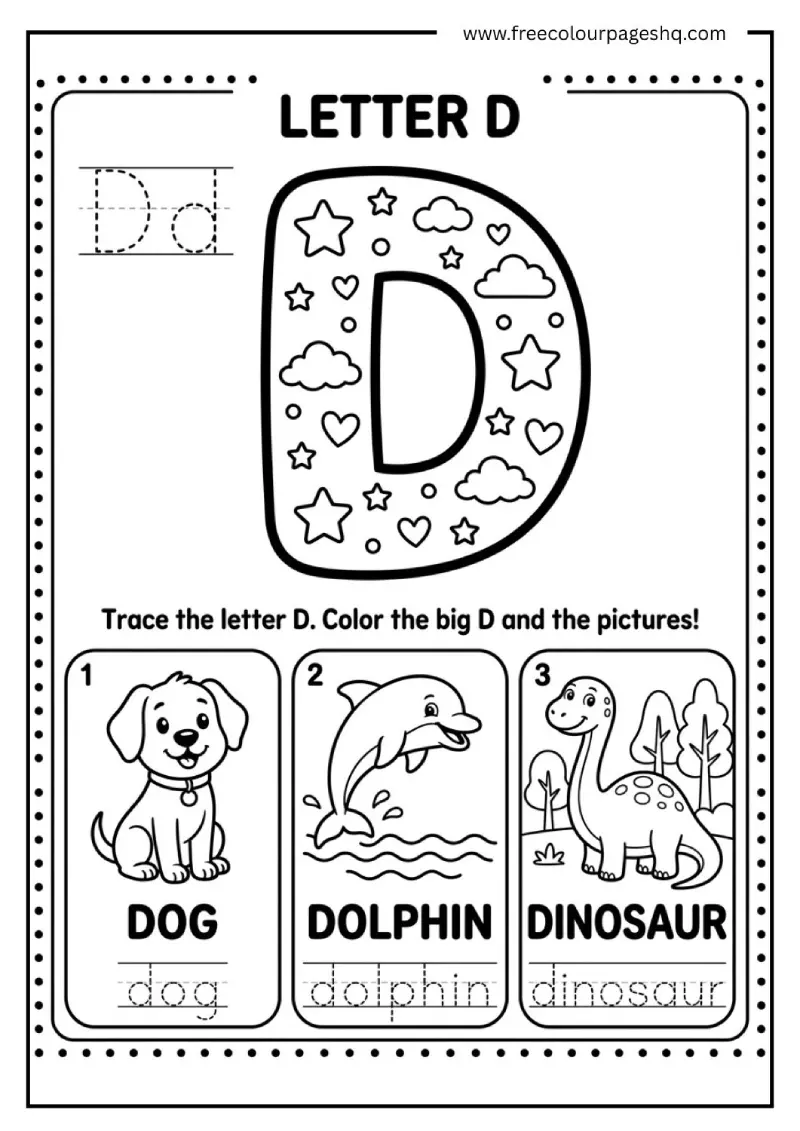
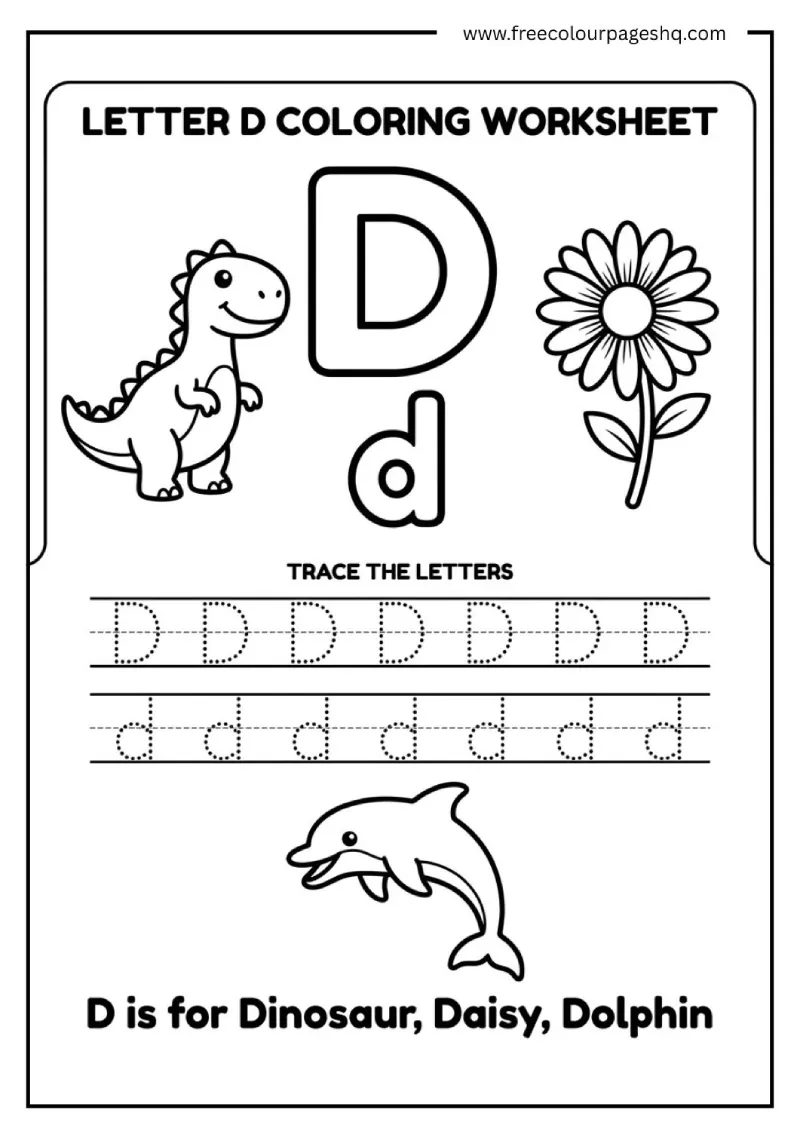
Preschool letter d coloring pages typically show the letter in a clear bold font beside a phonics illustration and include a simple tracing element at the bottom of the page. The page might show a large decorative D to colour at the top, a dog or duck illustration beside it, and five dotted D letters to trace along the bottom with stroke direction arrows. This three-part structure gives the page genuine educational utility alongside the creative activity.
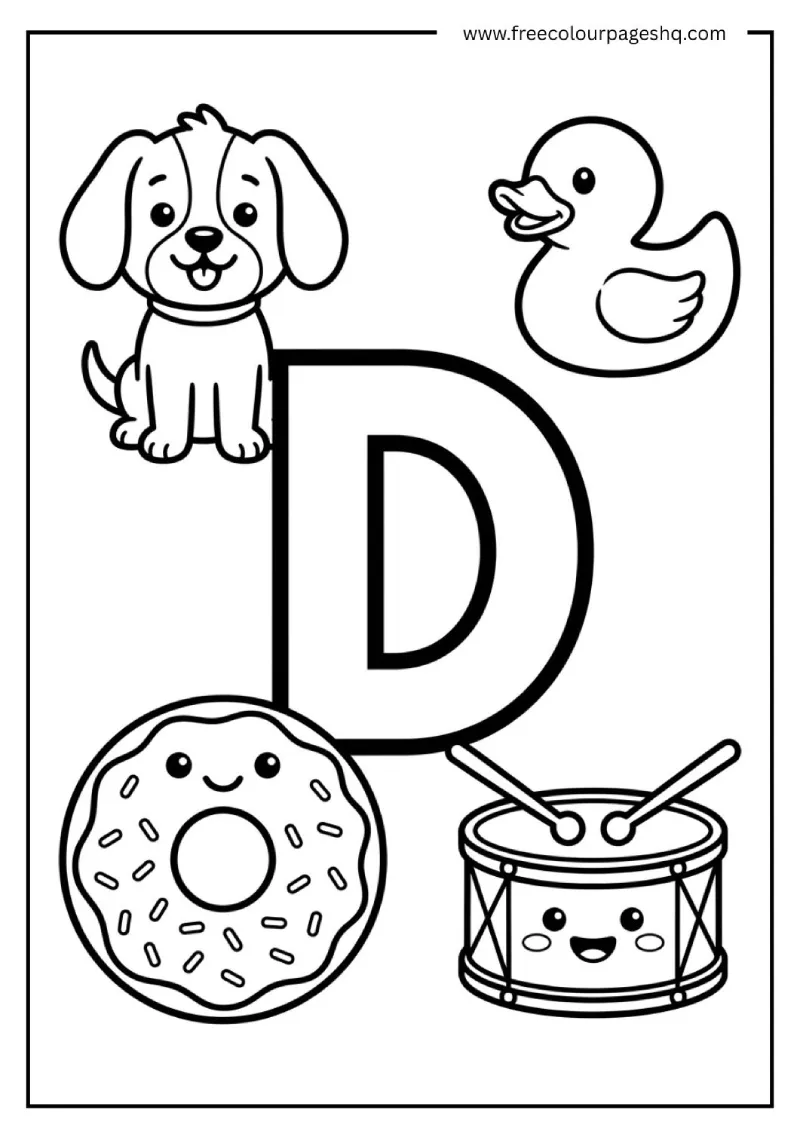
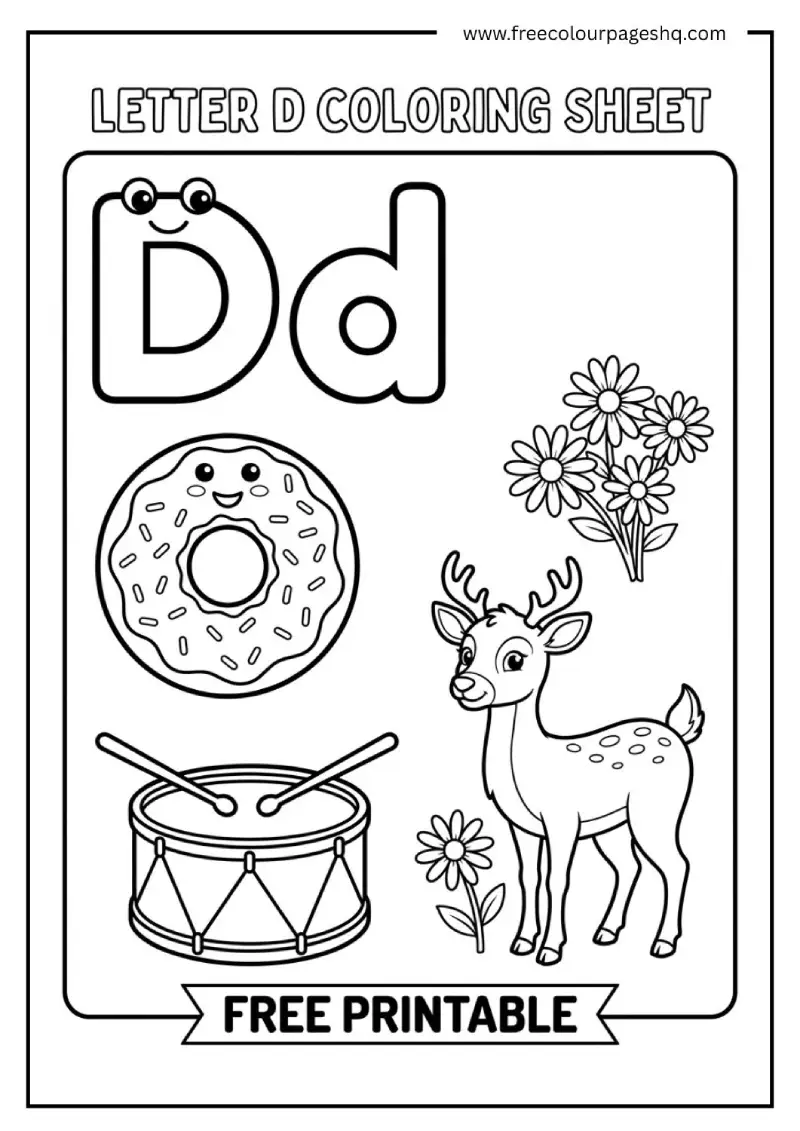
Preschool coloring pages for the letter d that incorporate multiple D words give teachers a vocabulary-building opportunity alongside the letter recognition activity. A page showing a dog, a duck, a donut and a drum arranged around a central letter D introduces four beginning-D words in a single session, all reinforced by the colouring activity that fixes each image and its initial letter in the child’s visual memory.
Letter d coloring pages preschool designs that introduce less familiar D words alongside the familiar ones, dragonfly alongside dog, daffodil alongside duck, extend vocabulary beyond what children already know rather than simply confirming what they know already.
D is for Dog Coloring Pages
The D is for Dog pairing is the most searched individual D-word combination in the alphabet coloring category. Dogs are among the first animals children learn to name, the first animal sound many children make, and one of the most consistent subjects of children’s picture books from the earliest board books onward.
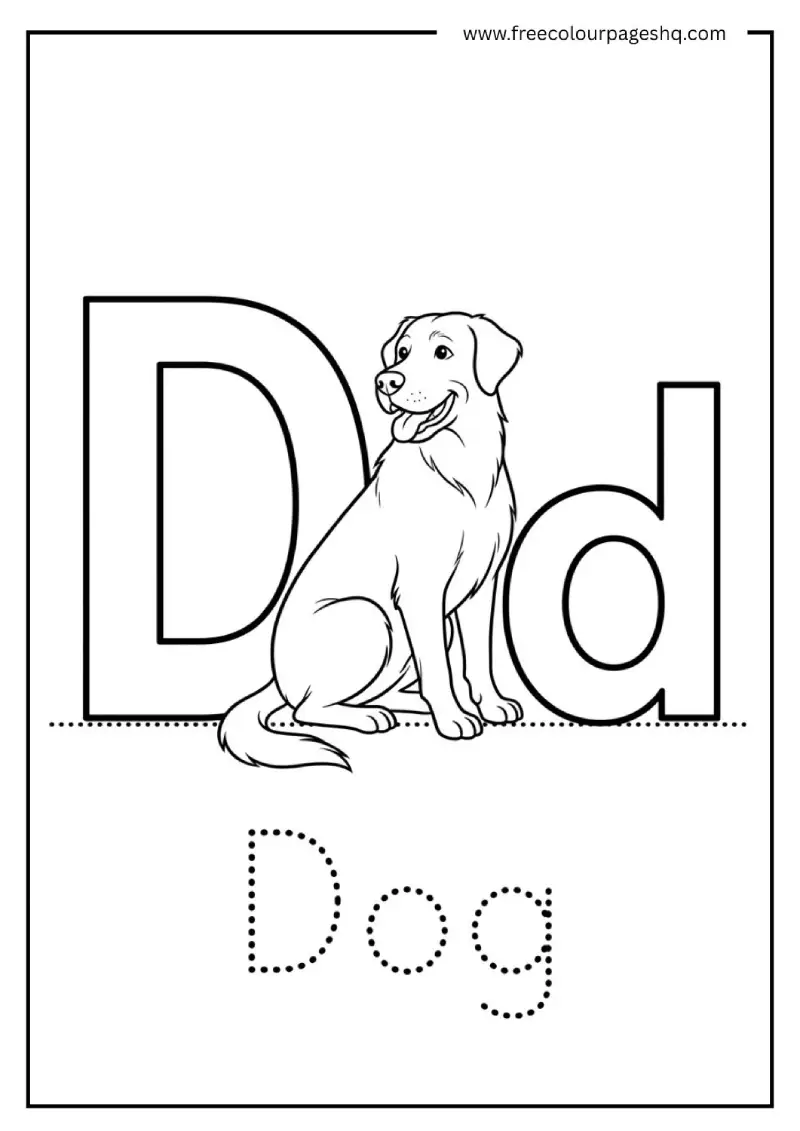
A d is for dog coloring page shows a large bold letter D beside a friendly dog in a clear recognisable pose. Floppy ears, a wagging tail, four visible paws and a happy expression give children the canonical cartoon dog that immediately reads as dog rather than any specific breed. The words D is for Dog in simple print or dotted tracing below complete the phonics encounter.
More detailed dog coloring pages for older children can show specific breeds, a Golden Retriever, a Dalmatian, a Dachshund, all beginning with the relevant letter D in a neat phonics bonus. These breed-specific pages suit children aged six and above who have the fine motor control to work with more interior detail.
D is for Dinosaur Coloring Pages
The d for dinosaur pairing is the second most searched D-word combination and one of the most enthusiastically received by children who encounter it. Dinosaurs occupy a specific and powerful place in childhood imagination. They are real, which gives them a different quality from dragons or unicorns, but they are also safely extinct, removed enough from present reality to feel fantastical.
A d for dinosaur coloring page typically shows the letter D beside a T-Rex in a characteristic pose, jaw open, short arms raised, the distinctive silhouette immediately recognisable to every child who has encountered dinosaur content in any form. Simpler versions for younger children show a rounder, friendlier dinosaur with the same characteristic features but without the implied menace of the fully realistic form.
Letter D dinosaur pages work particularly well in classroom contexts connected to prehistoric life learning units. A letter D coloring page becomes a science activity as well as a literacy activity when the child is simultaneously learning about Cretaceous ecosystems.
D is for Duck Coloring Pages
Duck is one of the earliest D words children learn, introduced through farmyard picture books and pond visits long before formal literacy education begins. The duck’s visual simplicity, round body, flat beak, small wings and characteristic upright stance, makes it one of the more achievable cartoon illustrations for young children to recognise and colour confidently.
A letter D coloring page featuring a duck works particularly well when it shows both a mother duck and a duckling beside the letter. The size contrast between adult and baby reinforces the visual interest of the page and gives younger children two distinct areas to colour with the same basic colour.
D is for Dolphin Coloring Pages
The dolphin is one of the most visually elegant D animals in the collection. A leaping dolphin shown mid-jump above ocean waves gives the letter D page a dynamic energy that sedentary subjects like drum or desk cannot match.
Alphabet letter d coloring pages featuring dolphins connect naturally to ocean learning units and work well alongside other marine animal coloring pages. The dolphin’s smooth streamlined shape with its characteristic curved dorsal fin and distinctive forehead is recognisable to virtually every child old enough to understand the alphabet.
D is for Dragon Coloring Pages
Dragon gives the letter D its fantasy dimension. Unlike the other D animals in the collection, the dragon is imaginary, which means children have more creative freedom when deciding what it looks like, what colour it breathes fire, whether it has two wings or four, whether it looks friendly or fierce.
Coloring pages for letter d featuring dragons work well for children who find realistic animal subjects less engaging than fantastical ones. The dragon page connects the phonics activity to a subject that children who love fantasy already have strong existing associations with.
Lowercase Letter D Coloring Pages
The lowercase d is arguably more important for reading development than the uppercase D because it appears far more frequently in actual reading text. Lowercase letters account for the vast majority of letters encountered in books, signs and written communication.
Lower case letter d coloring pages address a genuine educational gap because most alphabet coloring resources focus almost exclusively on uppercase letters. A dedicated lowercase d page, showing the characteristic tall vertical stroke with the round bump on the lower left, gives children specific attention on the form they will encounter most in reading.
The transition from uppercase D to lowercase d is slightly more complex than for letter C because the two forms look meaningfully different. Uppercase D has its curve on the right. Lowercase d has its circle on the left of the vertical stroke. Explicit teaching of both forms is genuinely important, and a coloring page showing both side by side gives children the comparison in a single visual.
Bubble Letter D Coloring Pages
Bubble letter d coloring pages move away from the educational phonics context toward a more purely creative purpose. The rounded puffed-out bubble letter form gives children a large forgiving shape to fill with colour without requiring precise control.
Letter d coloring pages printable in bubble letter format suit children aged six and above who want more creative latitude than standard block letter pages provide. The large open interior of a bubble D becomes a canvas for pattern work, polka dots, stripes, geometric shapes or gradient colour experiments from light at the center to darker tones at the edges.
Fancy and Decorative Letter D Coloring Pages for Adults
Fancy letter d coloring pages for adults treat the letter as a vehicle for decorative art rather than a phonics tool. The most popular adult D page formats are floral, botanical, stained glass and ornamental.
A floral letter d coloring page constructs the letter form from botanical elements. The vertical stroke formed by a climbing rose stem with open blooms. The curved section formed by daffodil stems bending naturally into the D shape. Leaves and tendrils filling the spaces between the flowers. These botanical letter designs are genuinely beautiful when completed with care and are among the most shareable finished results in the alphabet coloring category.
Letter d coloring pages for adults in a stained glass style divide the letter interior into geometric sections separated by thick lead line outlines, each section a different size and shape ready to fill with a distinct colour. These designs suit adult colorists who enjoy the graphic precision of stained glass aesthetics.
Letter D Mandala Coloring Pages
Mandala coloring pages letter d place the uppercase D at the center of a circular symmetrical composition with patterns radiating outward in concentric rings incorporating dolphin silhouettes, daisy petal shapes, diamond geometric forms and dragonfly wing motifs.
These designs acknowledge that adults may want to engage with alphabet themes in a format suited to extended creative sessions. The mandala structure provides clear compositional guidance while leaving significant colour decisions open to the colorist.
Letter d zentangle coloring pages use each section of the letter interior as a distinct pattern zone, filling it with a different repeating zentangle design. The vertical stroke section showing fine spiral work. The curved section showing diamond crosshatch. These pages are among the most time-consuming in the collection and the most distinctive when completed.
How to Use Letter D Coloring Pages in the Classroom
Letter of the week programmes give letter d coloring pages a natural home. During a D week, children colour a simple D is for Dog page on Monday, look for D sounds in the classroom and at home through the week, and complete a more complex D word web page on Friday as a week-end vocabulary summary.
Free printable letter d coloring pages work particularly well as take-home activity sheets at the end of a D week. A parent who receives a child’s carefully coloured D is for Dinosaur page has an immediate conversation opener about what other words start with the D sound, which extends the phonics learning naturally into the home environment.
Coloring pages for the letter d that incorporate both colouring and tracing serve dual classroom purposes. The colouring section engages children creatively while the tracing section below builds handwriting muscle memory for the specific letter being studied that week.
Printing Tips
All letter D coloring pages in this collection download as free PDF files. PDF format preserves label clarity and line quality at any print size and scales correctly to both US Letter and A4 paper without manual adjustment.
Print toddler and preschool designs at normal quality on standard 80gsm paper. Bold outlines print clearly at normal quality settings. For adult floral, mandala and zentangle designs with fine interior detail, 90gsm or slightly heavier paper handles layered coloured pencil work significantly better than standard printer paper.
Laminating a completed letter D coloring page produces a durable classroom display piece. A child’s carefully coloured D is for Dog page, laminated and displayed at eye level beside the equivalent pages for other letters, begins to form the classroom alphabet frieze that reinforces letter recognition every time a child passes it.
Conclusion
The letter D is where some of the most important early vocabulary lives. Dog, duck, dinosaur. These are words that children know and love before they know the alphabet, which makes the letter D an unusually welcoming entry point into phonics education. A letter D coloring page uses that existing enthusiasm as the engine for genuine literacy learning. The child who reaches for the orange crayon to colour a D is for Dinosaur page is simultaneously practising letter recognition, reinforcing beginning sounds and developing the fine motor control that makes handwriting possible.
Download whatever design fits whoever is going to colour it. Print a few extras for the classroom. The pages coloured most carefully are always the ones where the child already loved the subject before they picked up the crayon.
FAQ
Are these letter D coloring pages free?
Yes. Every page downloads as a free PDF with no sign-up, no watermark and no cost. Print as many copies as needed for personal, classroom or homeschool use.
What paper size do letter D coloring pages print on?
All files are formatted for US Letter and print cleanly on A4 paper without any manual adjustment.
What is the difference between uppercase D and lowercase d?
Uppercase D has a vertical stroke on the left with the curve on the right. Lowercase d has a circle on the left with the tall vertical stroke on the right. The two forms look meaningfully different, which makes teaching both explicitly important.
Which letter D coloring pages work best for toddlers?
Simple designs with very thick outlines, a single large D-word illustration and no fine detail. D is for Dog, D is for Duck and D is for Dinosaur pages with large open areas work best for children aged two to four.
Are there letter D coloring pages for adults?
Yes. Floral letter D designs, mandala coloring pages, stained glass D pages, zentangle designs and ornate decorative letter pages are made specifically for adult colorists.
Can these be used in a preschool classroom?
Yes. All pages print in multiple copies for group use and work well as letter-of-the-week activities, fine motor skill practice, take-home phonics sheets and classroom alphabet display projects.