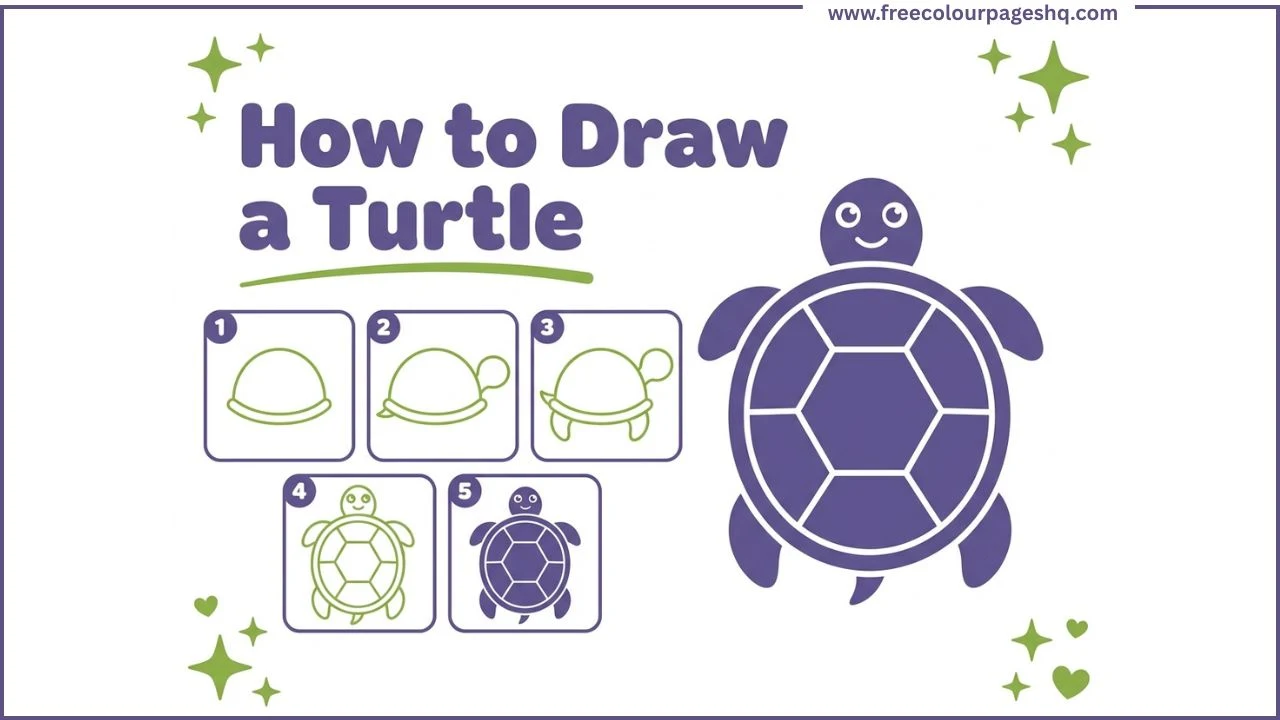
A turtle carries its home on its back, which is either the most practical or the most exhausting arrangement in the animal kingdom depending on how you look at it. The shell is the defining feature, immediately recognisable from any angle and at any scale, and it is also what makes drawing a turtle so satisfying. The dome shape establishes the drawing almost immediately, and from there the head, flippers and tail fall into place naturally. The shell pattern, that hexagonal mosaic of interlocking segments, is the detail that turns a simple dome into something that looks genuinely like a turtle.
This tutorial shows how to draw a cute cartoon turtle step by step in five stages. The method produces a front-facing sitting turtle with a dome shell, friendly face, four rounded flippers and a proper hexagon shell segment pattern. It works for complete beginners, for kids of all ages from preschool upward, and for anyone who wants a reliable turtle drawing method they can adapt into different styles. All you need is a pencil, an eraser and something to colour with at the end.
What You Need
A pencil and eraser for the drawing stages. Coloured pencils, crayons or markers for the finished turtle. Plain white paper works perfectly.
How to Draw a Turtle Step by Step
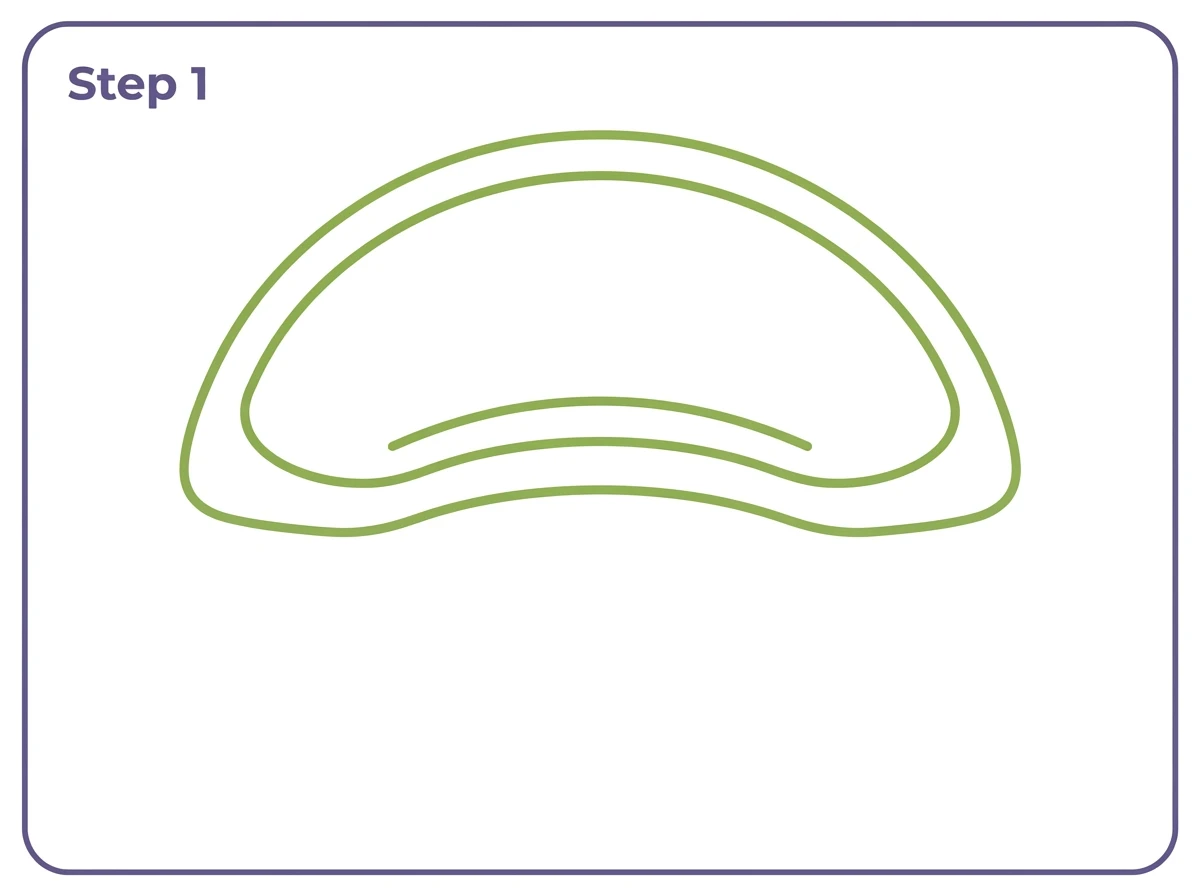
Step 1 — Draw the Dome Shell with Inner Rim
Start near the upper center of the page and draw a large dome shape for the turtle’s shell. The dome looks like a rounded hill or a flattened oval with a smooth curved top and a flat bottom edge. Draw it large enough that it takes up roughly the upper half of the page, leaving plenty of space below for the head, flippers and tail.
Inside the dome outline, draw a second parallel curved line running approximately one fifth of the way in from the outer edge. This inner line follows the exact curve of the outer dome all the way around, creating a shell rim or border that gives the shell an immediate sense of depth and three-dimensional structure. This double-line detail is the difference between a dome shape and a turtle shell shape, and it only takes a moment to add.
Step 2 — Add the Head, Neck and Tail
On the lower right side of the shell, draw a small round head connected to the shell by a short stubby curved neck. The head should be noticeably smaller than the shell and sit naturally at the shell’s right opening. The neck is a short open curved shape connecting the shell edge to the head rather than a closed tube.
On the opposite lower left side, add a small pointed triangular tail poking outward from the shell opening. The tail is short and simple, pointing slightly downward and to the left.
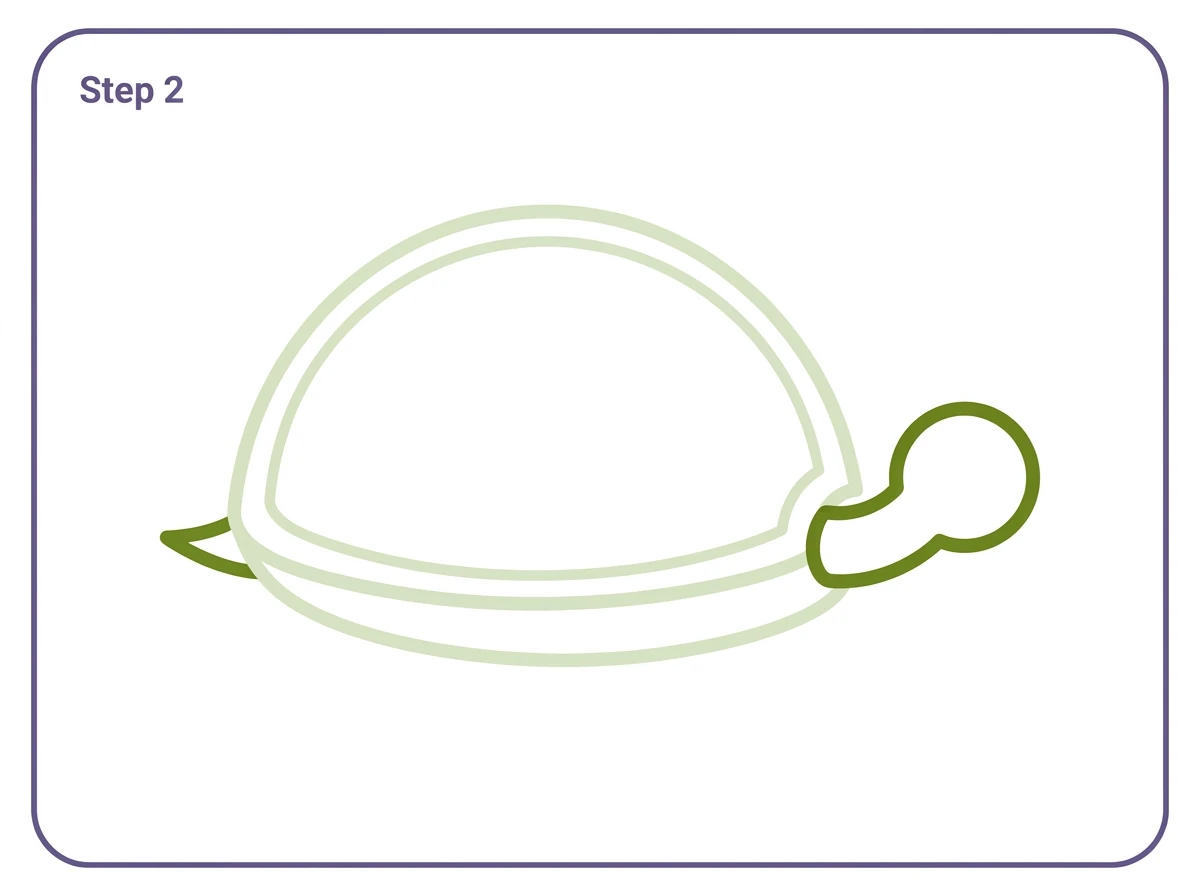
With just these three elements, the drawing already reads clearly as a turtle. The dome shell, the small protruding head and the small pointed tail are the three features that define the turtle silhouette in every culture’s visual representation of the animal.
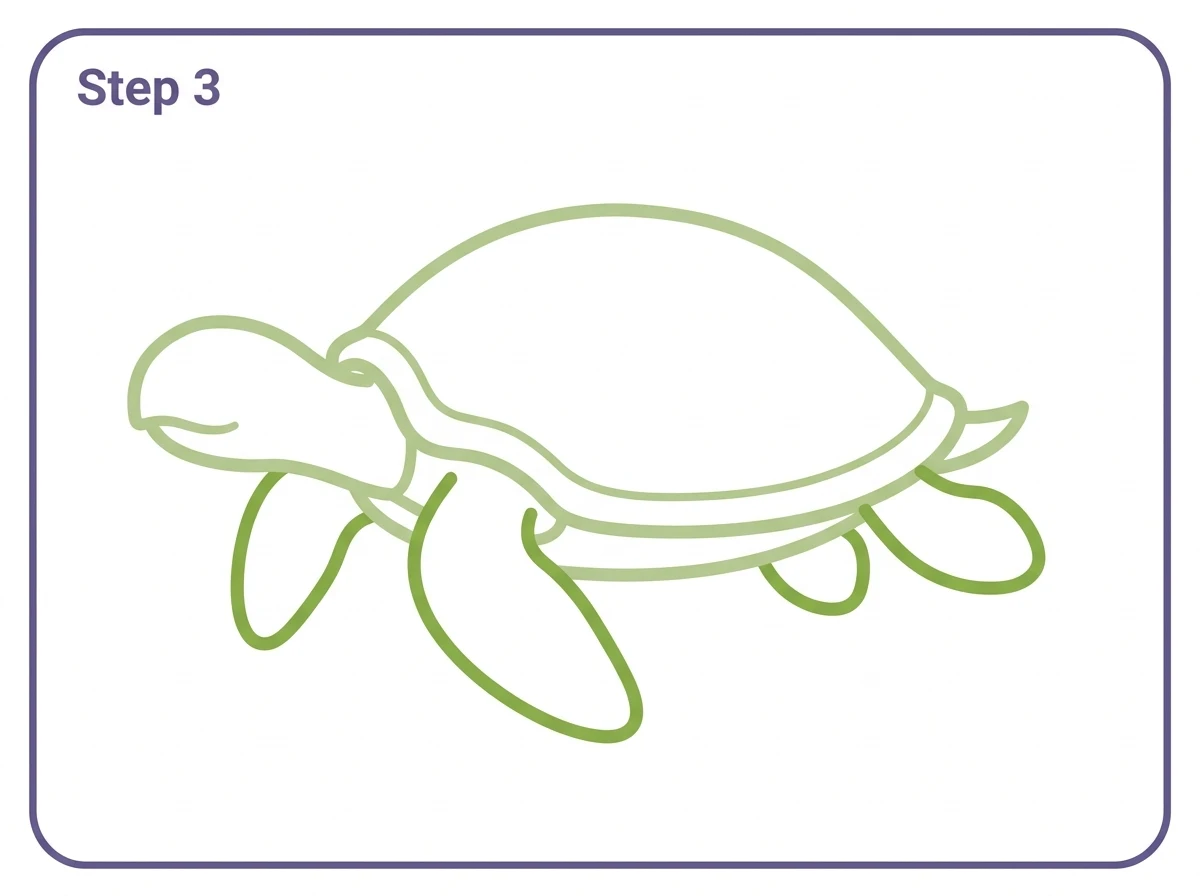
Step 3 — Draw the Four Flippers
Add four rounded flipper shapes extending from the sides and lower edge of the shell. Two front flippers extend forward and slightly outward from the lower front sides of the shell near the head, each shaped like a wide rounded oval or a broad leaf. Two smaller back flippers extend backward and outward from the rear lower sides near the tail, slightly shorter and rounder than the front ones.
All four flippers connect smoothly to the shell edge. The turtle now has a complete body silhouette with all five body elements in place: dome shell, head, neck, tail and four flippers. Even at this stage, before any detail has been added, the drawing is unambiguously a turtle.
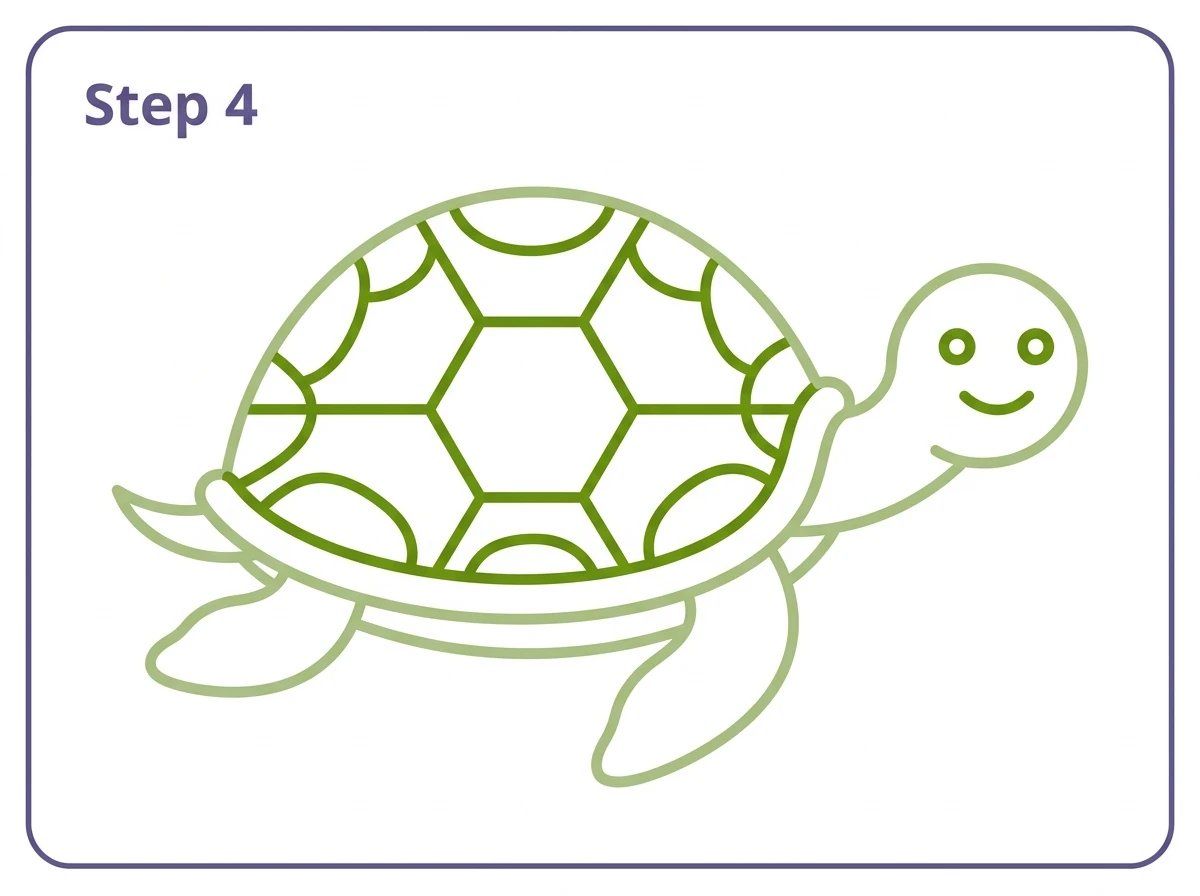
Step 4 — Add the Shell Pattern and Face
This is the step that transforms the drawing from a simple outline into a turtle drawing with genuine visual interest. Inside the dome, draw a hexagon shape in the center of the shell. From each of the six corners of the hexagon, draw straight lines extending outward toward the inner rim line. Then add smaller curved segment shapes in the spaces between the main hexagon lines, filling the dome interior with the classic turtle shell mosaic pattern.
The hexagon and radiating lines do not need to be geometrically perfect. Slightly irregular segments look more natural than a rigidly precise geometric construction, and the imperfection makes the finished drawing look more like a real shell than a diagram.
Inside the small round head, draw two small circle eyes side by side in the upper half of the face. Below the eyes, add a gentle upward curved smile. These three elements, two circles and a curve, give the turtle a friendly, cheerful expression.
Step 5 — Colour the Turtle
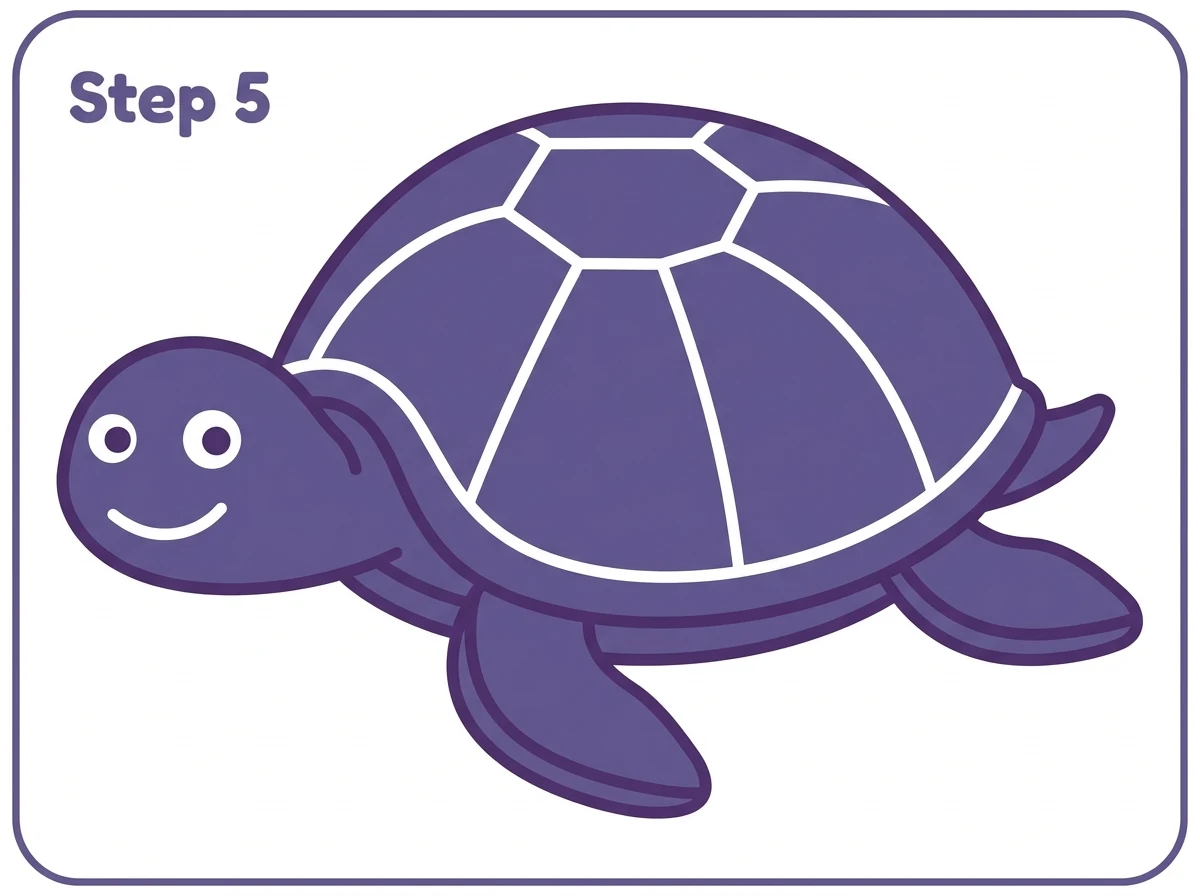
The turtle is now fully drawn and ready to colour. The colour choices for turtles vary significantly between species, which gives this step a wide range of creative possibilities.
A green sea turtle uses medium to dark green for the shell and a slightly lighter green for the head, neck, flippers and tail. The shell segments are typically darker at their centers and slightly lighter at the edges. A box turtle uses a dark brown or black shell with yellow or orange segment markings. A painted turtle uses a dark shell with yellow and red markings along the edges and bright yellow stripes on the neck and legs.
For a simple cartoon turtle, green and brown in combination produce the most universally recognisable result. A green body and flippers with a darker olive or brown shell, with the segment lines shown in a slightly lighter shade of the shell colour, works well at any level of colouring skill.
How to Draw a Sea Turtle
A sea turtle drawing uses the same basic dome construction but with specific differences that distinguish it from a land turtle or freshwater turtle. Sea turtle shells are flatter and more streamlined than the high-domed shells of land tortoises. The flippers are longer and more paddle-like, designed for swimming rather than walking, and the front flippers are significantly larger than the back ones.
For a simple sea turtle easy enough for kids, draw a flatter oval shell rather than the high dome used in this tutorial. The flippers should be longer and narrower than the rounded flipper shapes in the main tutorial, particularly the front pair which should extend to roughly the same length as the shell itself.
For a realistic sea turtle step by step, the shell pattern uses a different arrangement than the hexagon mosaic of land turtles. Sea turtle shells typically show five central scutes running down the length of the shell in a row with four pairs of larger lateral scutes flanking them on either side. These are more oval than hexagonal and are separated by clear lines rather than the mosaic pattern of land turtles.
A sea turtle in the ocean scene adds an underwater background, blue water gradients, coral visible below, other fish visible in the middle distance and the particular quality of light filtering through water from above. The sea turtle is one of the most graceful underwater subjects in animal drawing and the extended flippers show this grace more effectively than a sitting land turtle pose.
How to Draw a Turtle Shell Pattern
The turtle shell pattern is the detail that most children want to understand once they have mastered the basic turtle outline. Different turtle species have different shell structures, but the classic coloring-book turtle shell uses the hexagon-and-radiating-lines pattern described in Step 4.
A more accurate land turtle shell shows individual scutes, which are the plate-like structures that cover the shell surface. There are typically five central scutes running down the spine, called vertebral scutes, four pairs of larger scutes on either side called costal scutes, and a row of smaller scutes around the outer edge called marginal scutes. Drawing the shell this way, starting with the five central vertebral scutes and adding the costal scutes on either side, produces a more scientifically accurate result.
For a sea turtle shell easy to draw, replace the hexagons with a simpler arrangement of five oval shapes in a central row with pairs of slightly larger ovals flanking them. This captures the essential character of a sea turtle shell without requiring precise geometric work.
How to Draw a Baby Turtle
A baby turtle drawing uses the same dome-and-flipper construction but with specific proportions that communicate youth. The head should be very large relative to the shell, much larger than the proportions used in the main tutorial. Baby turtles genuinely do have oversized heads relative to their shell size at hatching. The flippers should look slightly too large for the body, which is also accurate for hatchling turtles. The shell should be rounder and higher-domed than an adult turtle’s shell.
A baby sea turtle drawing can add the beach hatching context. Multiple small domes visible in the sand suggesting the nest the hatchling has just emerged from. A trail of small flipper marks leading from the nest to the ocean. The hatchling heading toward the water. This scene tells a complete and genuinely dramatic natural history story.
How to Draw a Cute Turtle
A cute turtle or kawaii turtle drawing uses the same construction as this tutorial but with exaggerated proportions. The head circle should be larger relative to the shell. The eyes should take up most of the face, with prominent sparkle highlights inside each eye. The smile should be wide and slightly open. The overall shell should be shorter and rounder, almost like a circle, and the flippers should be smaller and more symmetrical.
Adding small rosy circles on the cheeks of the turtle face pushes the design firmly into kawaii territory. A cute turtle holding a small object in its front flipper, a flower, a tiny heart shape, adds character without requiring additional drawing complexity.
Turtle Drawing Tips for Beginners
The shell dome shape benefits from being drawn lightly first and adjusted before the inner rim line is added. The two lines that form the shell need to be evenly spaced all the way around, which is much easier to achieve if the outer line is clearly established before the inner one is begun.
The hexagon shell pattern looks more convincing when the lines are drawn freehand rather than with a ruler. A slightly irregular hexagon and slightly uneven radiating lines produce a more natural shell texture than a geometrically precise construction. Turtles do not have perfectly geometric shells in real life and the drawing should reflect that.
The face expression in a turtle drawing is almost entirely determined by the angle of the smile line. A flat horizontal line produces a neutral expression. A slight upward curve produces contentment. A stronger upward curve produces joy. Downturning the line produces concern or sadness. Since the only other face elements are two circles for eyes, the smile is carrying most of the expression work and a small adjustment has a large effect.
Fun Facts About Turtles for Kids
Turtles are one of the oldest groups of reptiles on Earth, with fossil records showing essentially the same body plan in turtles dating back over 200 million years. They survived whatever ended the dinosaurs and have continued largely unchanged.
A turtle’s shell is not a separate structure that the turtle lives inside. It is part of the turtle’s skeleton, formed from modified ribcage bones and spine fused to the shell plates. A turtle cannot leave its shell any more than a human could leave their ribcage.
Sea turtles can hold their breath for up to seven hours when they are resting or sleeping. During active swimming they typically surface every few minutes to breathe.
The temperature at which sea turtle eggs incubate determines the sex of the hatchlings. Warmer temperatures tend to produce more female turtles and cooler temperatures tend to produce more males. This makes sea turtle populations particularly sensitive to changes in beach temperature.
The largest living turtle species is the leatherback sea turtle, which can grow to over two meters in length and weigh more than 900 kilograms. It is also the fastest sea turtle, capable of speeds above 35 kilometers per hour in the water.
Some turtle species can live for over a hundred years. The oldest verified individual turtle on record, a Seychelles giant tortoise named Jonathan, was estimated to be around 190 years old as of 2024.
Colouring Tips for Turtle Drawings
The shell pattern is the most interesting colouring challenge in a turtle drawing. The most effective approach is to colour each shell segment individually rather than colouring the whole shell in one pass. Slightly varying the pressure or shade within each segment, darker at the center of each hexagonal segment and lighter at the edges, produces a textured result that looks considerably more like a real shell surface than flat uniform colour.
For a green sea turtle, the skin colour is not a single green. It is a warm olive green with darker green-brown tones toward the spine and lighter yellowish tones on the underside and around the face. Using at least two tones of green rather than one single shade gives the turtle drawing a much more naturalistic quality.
The eyes are worth spending extra time on. A small white sparkle dot left unpainted inside each eye, as described in the drawing tutorial above, makes the finished eyes look bright and alive against whatever colour the shell and body are given.
Printable Turtle Outline PDF
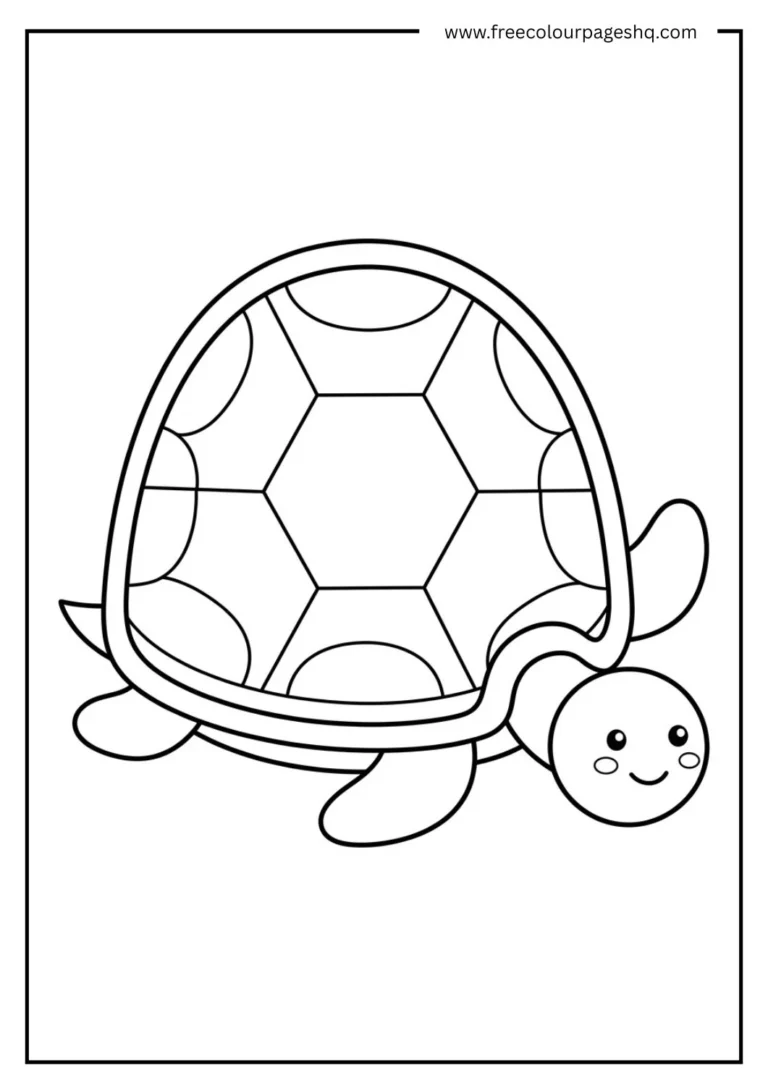
A printable turtle outline based on the finished Step 5 design is available as a free download below. Print it on plain white paper and use it as a colouring page, a drawing reference or a craft template. The outline includes all the completed line details from the tutorial including the hexagon shell pattern, and works as a standalone colouring page even for children who have not completed the drawing tutorial.
For more turtle designs to colour, visit our turtle coloring pages collection which includes designs from simple outlines for toddlers to detailed realistic sea turtle scenes for adults. Our full animals coloring pages category covers turtles alongside lions, tigers, dogs, cats and many more.
Explore more Free Printable Coloring Collections
Looking for more engaging activities? Check out these free printable coloring pages fun for kids, useful for teachers, relaxing for adults, and inspiring for designers.
FAQ
What is the easiest way to draw a turtle?
Start with a large dome shape for the shell. Add a second inner parallel line following the dome shape to create the shell rim. Add a small round head on one side connected by a short neck and a small pointed tail on the opposite side. Add four rounded flippers. Draw a hexagon and radiating lines inside the dome for the shell pattern and add two circle eyes and a smile on the head. This five-step method is reliable for beginners of all ages.
How do you draw a turtle for kids?
Use the simplified version of this tutorial. Draw a dome shell with an inner rim line. Add a round head and a small tail. Add four rounded flippers. Draw simple shell markings inside the dome. Give the head two dot eyes and a curved smile. This version takes about ten minutes and produces a recognisable cheerful turtle that children aged three and above can colour successfully.
How do you draw a turtle shell pattern?
Draw a hexagon shape in the center of the shell dome. From each corner of the hexagon, draw straight lines extending outward toward the shell rim. Fill the spaces between the lines with smaller curved segment shapes. The combined effect of the central hexagon, the radiating lines and the surrounding smaller segments creates the classic turtle shell mosaic pattern.
How do you draw a sea turtle easy?
Use a flatter oval shell than the high dome used for a land turtle. Make the front flippers significantly longer and more paddle-like, extending to roughly the same length as the shell. Make the back flippers shorter and more rounded. Use a five-oval shell pattern running down the center of the shell rather than the hexagon-and-lines pattern used for land turtles.
How do you draw a baby turtle?
Use a larger head relative to the shell than in an adult turtle drawing. Make the flippers slightly oversized relative to the body. Use a rounder higher-domed shell shape. These three proportion adjustments communicate youth effectively and produce a result that reads as a hatchling turtle rather than an adult.
Can beginners draw a realistic turtle?
Yes. A realistic turtle drawing starts with the same dome construction as this tutorial but uses observed reference photographs to get the shell scute arrangement accurate and adds pencil shading to suggest the three-dimensional form of the shell and the texture of the skin. The hexagon pattern in this tutorial is already a step toward a realistic shell and can be developed into a fully accurate scute diagram with reference material.