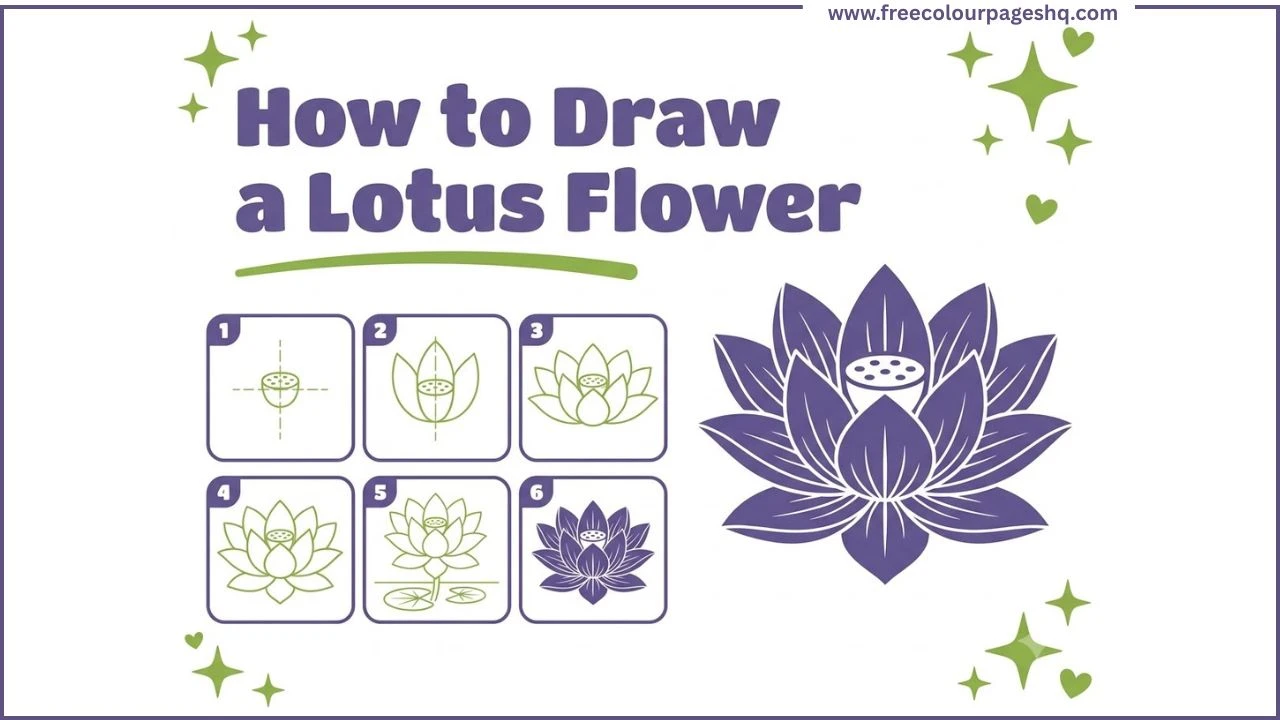
The lotus flower is one of the most drawn flowers in the world, and once you understand its structure it is easy to see why. It has a clear layered architecture that rewards methodical drawing. Start with the center. Build the inner petals. Add the outer petals behind them. Add the stem and leaves. The finished result is genuinely beautiful at every skill level from the simplest version to the most detailed.
This tutorial shows how to draw a lotus flower step by step in six stages using a seed pod center and symmetry guide as the foundation. It works for beginners, for kids and for anyone who has wanted to draw a lotus but was not sure where to start.
What You Need
A pencil and eraser. The symmetry cross guide drawn in Step 1 is temporary and should be erased cleanly later. Coloured pencils, crayons or markers for the finished drawing.
How to Draw a Lotus Flower Step by Step
Step 1 — Seed Pod Center and Symmetry Guide
Start near the upper center of the page. Draw a small circle for the lotus seed pod. Through the center of this circle draw a vertical line and a horizontal line forming a cross.
The vertical line is slightly longer than the horizontal line because the flower will be taller than it is wide.
These crossed guide lines are the most important element in the entire drawing. They tell you exactly where the center of the flower is and ensure that the petals on the left and right match each other. Draw the cross lines lighter than the seed pod circle so they are easy to erase later.

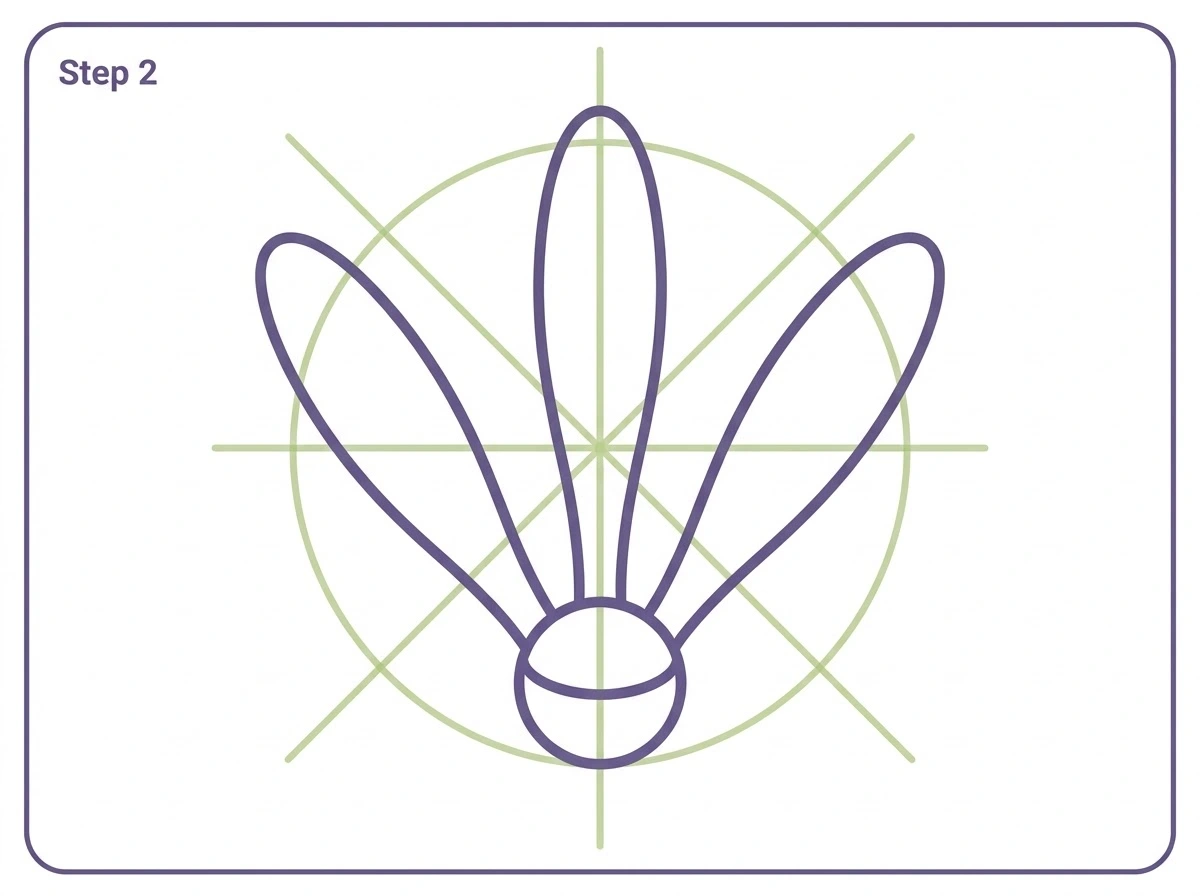
Step 2 — First Inner Petal Layer
Draw three tall narrow petals rising upward from around the seed pod. One central petal pointing straight up along the vertical guide line. Two petals angling slightly left and right following the diagonal spaces between the guide lines.
Each petal is a narrow elongated teardrop shape, wider at the base and tapering to a rounded or slightly pointed tip. These three inner petals form the heart of the bloom.
Draw them so their bases overlap slightly around the seed pod rather than simply touching it.
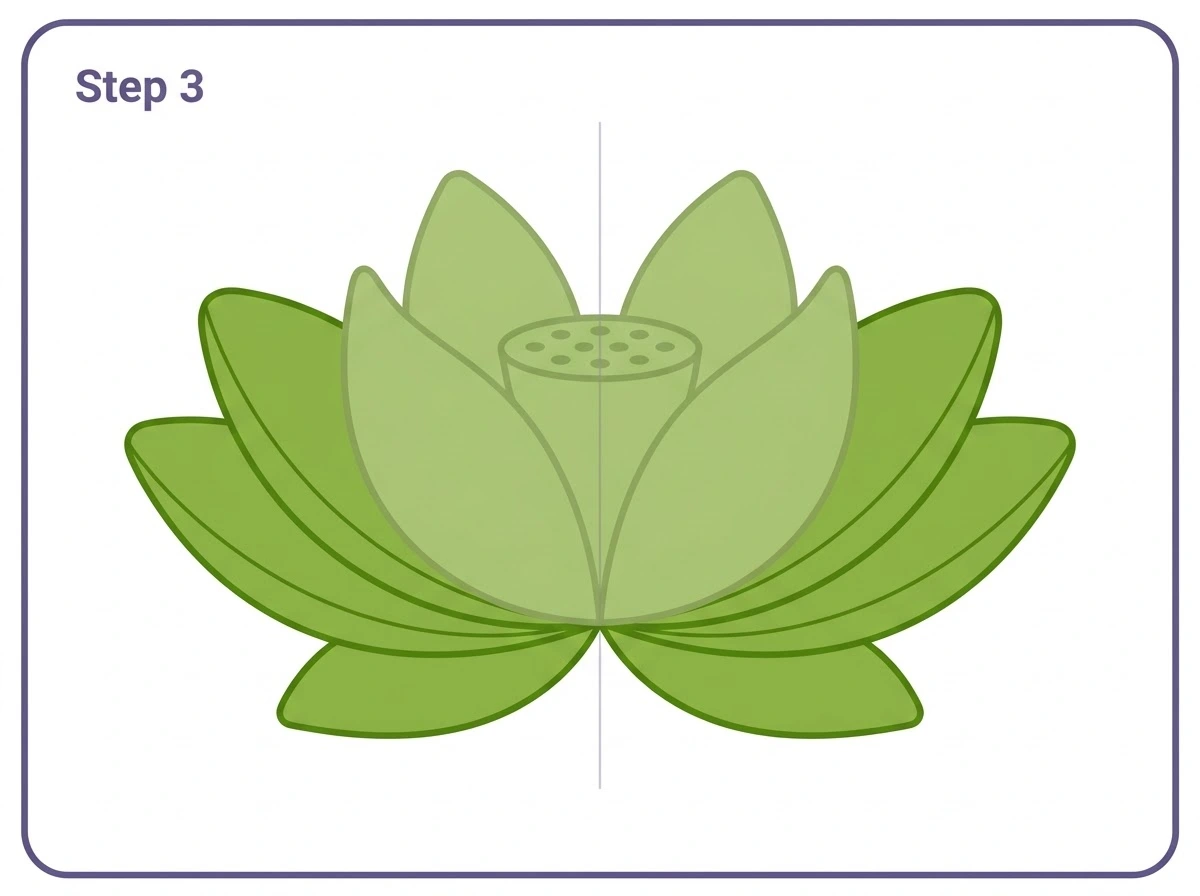
Step 3 — Second Middle Petal Layer
Add four or five wider petals appearing from behind the inner petals. These middle layer petals are broader and slightly taller than the inner petals. Their bases are visible below the inner petals and their rounded tips peek out from between and beside the inner petals.
These middle petals give the lotus its characteristic fullness. A lotus without this second layer looks sparse. With it the flower begins to read as genuinely lush.
Place them symmetrically on either side of the center vertical guide.
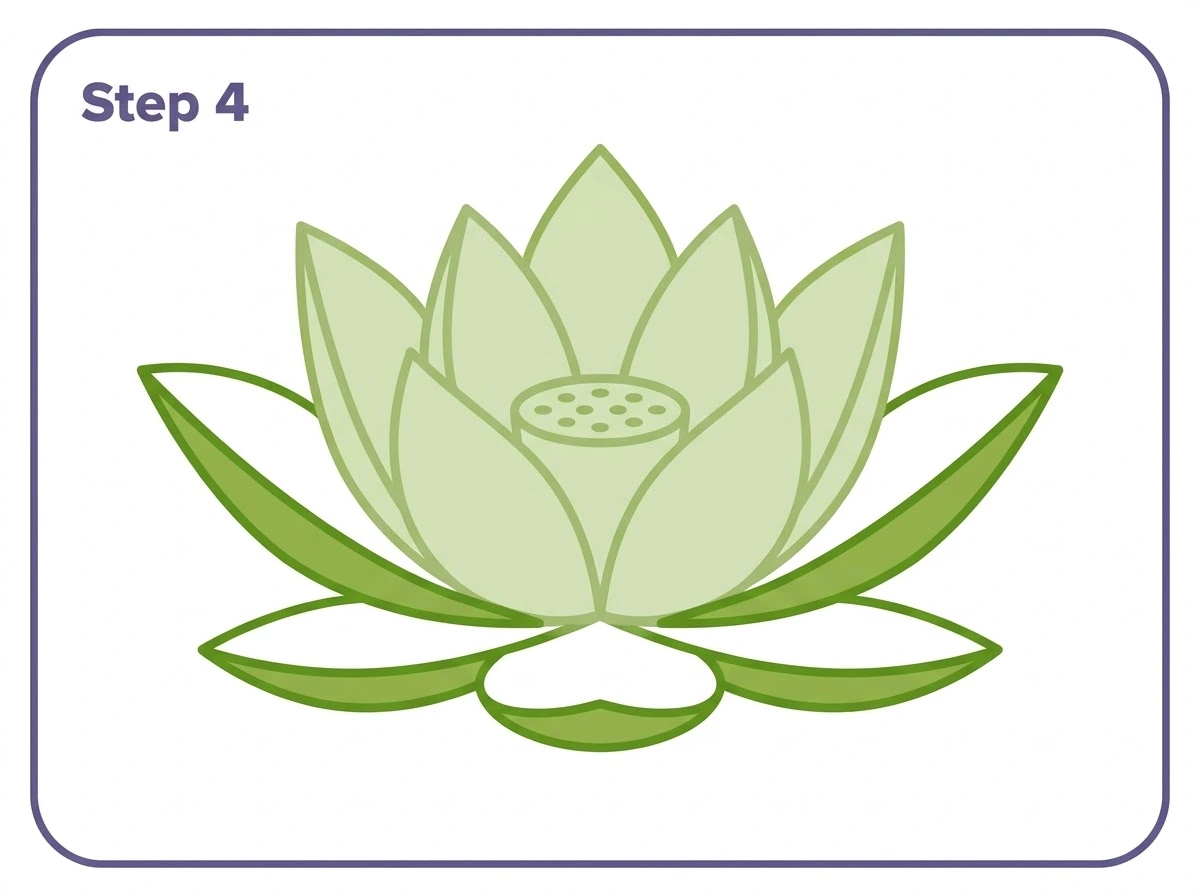
Step 4 — Outer Petals and Lower Spreading Petals
Add a third outer layer of larger petals spreading outward and slightly downward on each side of the flower. These are the widest petals in the composition and they angle away from center at about forty-five degrees.
Below the main bloom, draw two or three shorter wider petals spreading almost horizontally outward. These lower petals form the skirt of the flower and complete the lotus silhouette.
The finished flower outline should now look like a full open bloom. Step back and check that both sides are roughly symmetrical before moving on.
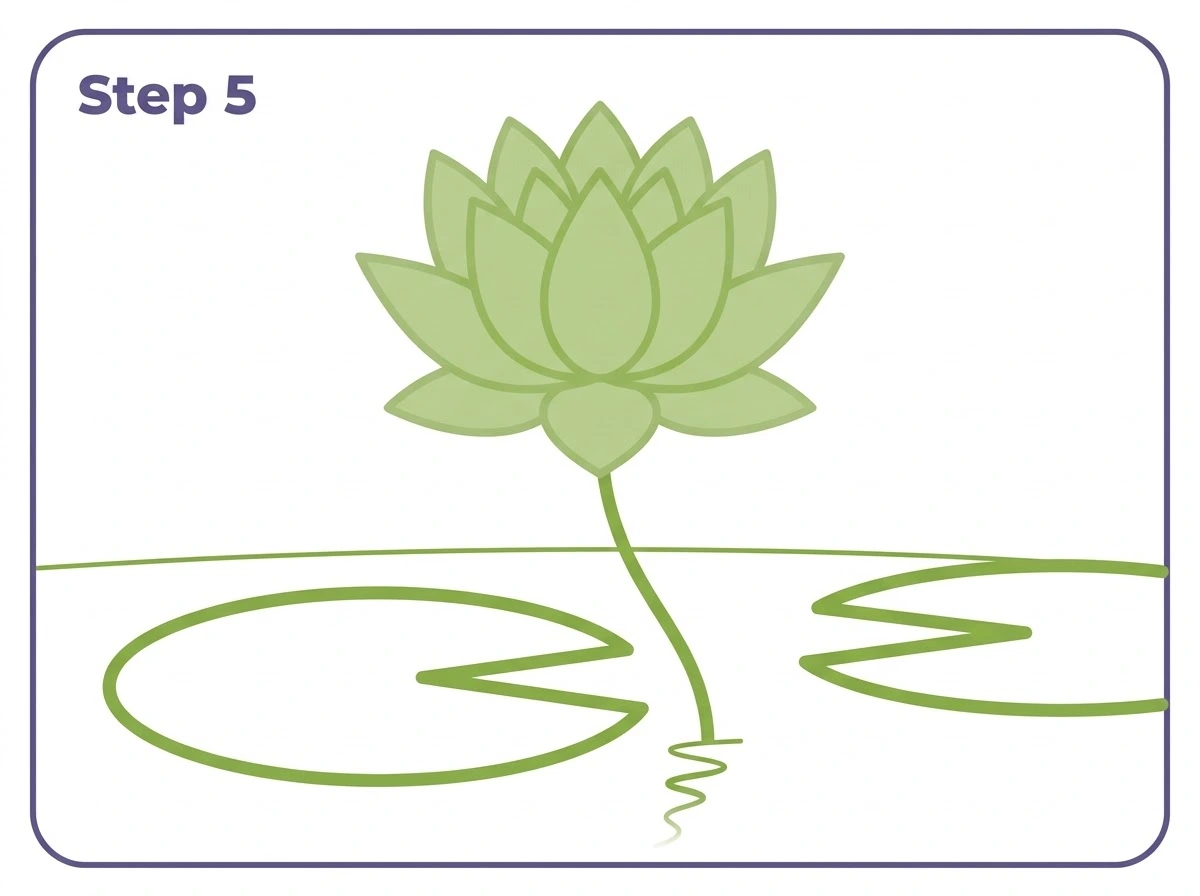
Step 5 — Stem, Lily Pad Leaves and Water Line
Draw a single curved stem line descending from the base of the flower downward to a horizontal water surface line across the lower portion of the page.
On the left side of the stem, draw a large rounded lily pad leaf shape sitting on the water surface. A second smaller lily pad on the right side of the stem, partially overlapping. Each lily pad has a characteristic V-shaped notch cut into one side.
A wavy reflection line just below the water surface suggests the stem’s reflection in the still pond water.
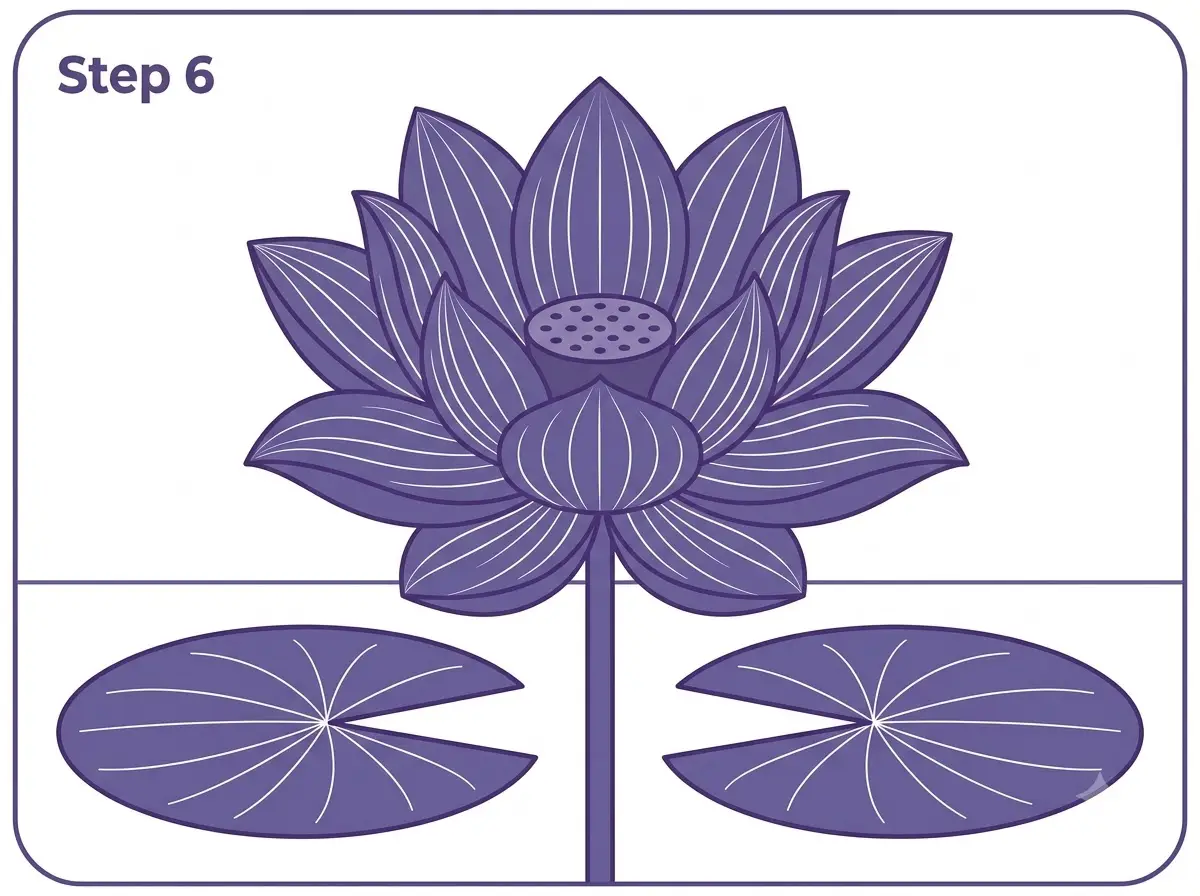
Step 6 — Colour the Lotus Flower
The lotus is ready to colour. Pink is the most associated colour for the classic lotus, ranging from very pale blush pink at the petal tips to a deeper rose pink at the bases where the petals overlap.
White and cream lotuses are also very common in nature and produce a serene, clean result on paper.
For the seed pod, warm yellow or pale orange suggests the circular seed head structure. The lily pads are a medium green, slightly darker at the outer edges where the leaf curls. The stem is a similar green to the lily pads, slightly darker.
A touch of darker pink at the bases of the petals where they overlap and lighter pink toward the tips creates a sense of depth without requiring advanced shading skills.
How to Draw a Lotus Flower Easy for Kids
A simplified lotus easy enough for very young children reduces the tutorial above to four elements. A small circle center. Three large petals around it. A curved stem below. Two rounded leaf shapes at the bottom.
This four-element version takes about five minutes and produces an immediately recognisable lotus flower. The seed pod can be given a simple smiley face to make it a character rather than a botanical subject, which many young children find engaging.
How to Draw a Simple Lotus Flower Step by Step
The simplest complete lotus drawing uses just the inner three petals plus the stem and lily pad, skipping the middle and outer petal layers entirely. This three-petal lotus takes less than ten minutes and looks charming rather than incomplete because the three-petal arrangement is actually how some varieties of lotus look in bud stage.
For a simple lotus flower for beginners, drawing the petals as smooth ovals rather than the more complex teardrop shapes also works well. The oval petals are slightly less accurate botanically but considerably more achievable as a first attempt.
How to Draw a Lotus Flower in a Pond
Adding a full pond setting around the lotus drawing transforms it from a flower study into a complete nature scene.
Beyond the lily pad leaves from Step 5, add additional lily pads at different sizes scattered across the water surface. Some can overlap the edges of the drawing. A few lotus buds on shorter stems, shown as elongated oval shapes that have not yet opened, add variety to the scene.
Small circular ripple rings around each stem where it enters the water add realism. A few dragonflies or damselflies above the water surface, drawn as simple cruciform shapes with long thin bodies, are perfectly associated with lotus pond settings.
The water itself can be suggested with gentle horizontal wavy lines below the water surface line.
How to Draw a Lotus Flower Mandala
A lotus mandala places the flower in a circular symmetrical composition. The lotus itself forms the center of the mandala, with its petals becoming the innermost ring of the symmetrical pattern. Successive rings outward incorporate lotus petal shapes at smaller scales, geometric forms, dot patterns and decorative border elements.
To draw a lotus mandala, start with the six-step lotus from the main tutorial at the center of the page. Then use a compass or freehand to draw concentric circles around it at regular intervals. Fill each ring with repeating pattern elements, always maintaining the rotational symmetry of the composition.
Lotus mandalas are popular as adult colouring pages because the symmetrical structure provides compositional guidance while leaving significant colour decisions open.
How to Draw a Beautiful Lotus Flower with Pencil
For a detailed pencil lotus, the approach changes from the coloured drawing above. Shading does the work that colour would otherwise do.
Start with the same six-step construction. Then begin shading from the base of each petal where it overlaps another petal. The areas where petals overlap are the darkest because they are in shade. The outer surfaces of each petal facing the imaginary light source are the lightest.
Use short curved pencil strokes following the surface direction of each petal rather than shading in random directions. The strokes on a petal pointing upward run from base to tip. The strokes on a petal curving to the side follow that curve.
The seed pod in a pencil drawing is shown with a grid of small dots or circles suggesting the individual seed holes visible on a real lotus pod.
How to Draw a Realistic Lotus Flower
A realistic lotus drawing requires observation of real lotus photographs or botanical illustrations. The key structural details that distinguish a realistic lotus from a simplified cartoon version are: the slight variations in petal size and angle that make each petal different from its neighbour; the visible veining on each petal running from the base to the tip; the detailed texture of the seed pod surface; and the specific quality of the light that seems to glow through the thin petals when they are backlit.
For the petals: each one has a main central vein and several branching secondary veins. These are drawn as very fine curved lines running from the petal base toward the tip.
For the seed pod: the surface shows a distinctive pattern of circular holes in a regular grid where each seed sits.
The Lotus Flower in Art and Culture
The lotus has one of the longest histories in decorative art of any flower. It appears in ancient Egyptian art as a symbol of creation and rebirth, representing the sun rising from the water. In Hindu and Buddhist traditions the lotus represents purity, enlightenment and the ability to rise above difficult circumstances. The image of the lotus growing from muddy water to bloom above the surface is one of the most widely used metaphors for spiritual development across multiple cultures.
In Japanese art the lotus appears in woodblock prints alongside herons and koi. In Chinese art it symbolises purity and is associated with summer. The Sacred Lotus, Nelumbo nucifera, is the national flower of India and Vietnam.
This cultural weight is part of what makes the lotus such a compelling drawing subject. It carries meaning that most other flowers do not.
Fun Facts About the Lotus for Kids
The lotus can regulate its own temperature. Even on cold mornings a lotus bloom can maintain its temperature significantly above the surrounding air. This thermogenesis attracts the insects that pollinate it.
Lotus seeds are extraordinarily long-lived. Seeds found in an ancient lake bed in China germinated successfully after being dormant for approximately 1,300 years.
The lotus has a remarkable self-cleaning surface. The microscopic texture of its petals causes water droplets to roll off, carrying dirt with them. This property has inspired engineers designing self-cleaning materials and surfaces.
All parts of the lotus plant are edible. The seeds, roots, stems, leaves and petals are all used in cooking across South and East Asia. Lotus root is particularly popular in Chinese, Japanese and Korean cuisine.
Printable Lotus Flower Outline PDF
A printable lotus flower outline based on the finished Step 6 design is available as a free download below. Use it as a colouring page, a drawing reference or a craft template.
Explore more Free Printable Coloring Collections
Looking for more engaging activities? Check out these free printable coloring pages fun for kids, useful for teachers, relaxing for adults, and inspiring for designers.
FAQ
What is the easiest way to draw a lotus flower?
Draw a small seed pod circle with a cross symmetry guide. Add three tall inner petals rising from the pod. Add wider middle layer petals behind the inner ones. Add outer petals spreading at the sides and lower spreading petals below. Add a curved stem, lily pad leaves and a water surface line. This six-step method works at all skill levels.
How do you draw a lotus flower for kids?
Draw a circle center, three large rounded petals around it, a curved stem below and two rounded leaf shapes at the bottom. This four-element version takes five minutes and produces an immediately recognisable lotus. Add a smiley face on the seed pod to make it more appealing to young children.
How do you draw a lotus flower in a pond?
Complete the six-step lotus tutorial. Add more lily pad shapes at different sizes across the water surface. Draw lotus buds on shorter stems as unopened oval shapes. Add circular ripple rings where each stem enters the water. Use gentle horizontal wavy lines to suggest the water surface. Add dragonflies or damselflies above the water for a complete pond scene.
How do you draw a realistic lotus flower?
Use botanical illustration reference. Draw fine curved vein lines running from the base to the tip of each petal. Show the seed pod surface texture as a regular grid of small circles suggesting the individual seed holes. Vary the angle and size of each petal slightly to reflect natural rather than perfectly symmetrical growth.
What colours does a lotus flower come in?
Lotus flowers are most commonly pink, ranging from very pale blush to deep rose. White and cream lotuses are also common. Yellow and blue lotus varieties exist in some species. In drawing, pink with deeper pink at the petal bases produces the most immediately recognisable lotus colouring.
Why does the lotus flower have cultural significance?
The lotus grows from muddy water to bloom above the surface, which across multiple cultures represents purity, enlightenment and the ability to transcend difficult circumstances. It appears in ancient Egyptian, Hindu, Buddhist, Chinese and Japanese art and symbolism, and is the national flower of India and Vietnam.