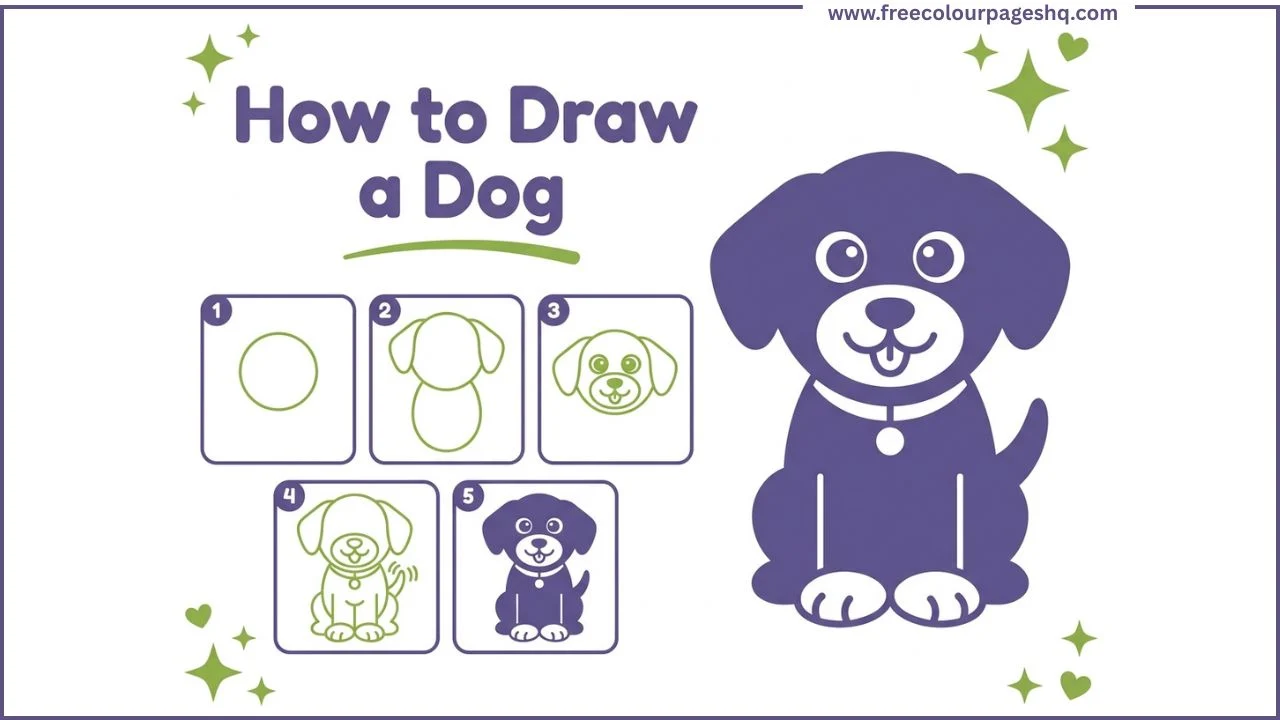
Dogs are one of the first animals most children want to draw, and also one of the most frustrating, because the gap between what a dog looks like in your head and what appears on paper can feel enormous on a first attempt. The secret is that dogs, like most animals, break down into simple shapes that anyone can draw. A circle for the head. An oval for the body. Floppy ears and a wagging tail. Once these pieces are in place, the drawing looks like a dog before it is anywhere near finished, which makes the whole process feel considerably less intimidating.
This tutorial shows how to draw a cute cartoon dog step by step in five stages. The method works for complete beginners, for kids in Class 1 and 2, and for anyone who wants a reliable dog drawing method they can repeat with different breeds and styles. All you need is a pencil, an eraser and something to colour with at the end.
What You Need
A pencil, an eraser and plain white paper. Coloured pencils, crayons or markers for the finished drawing. No special art supplies needed.
How to Draw a Dog Step by Step
Step 1 — Draw the Head Circle
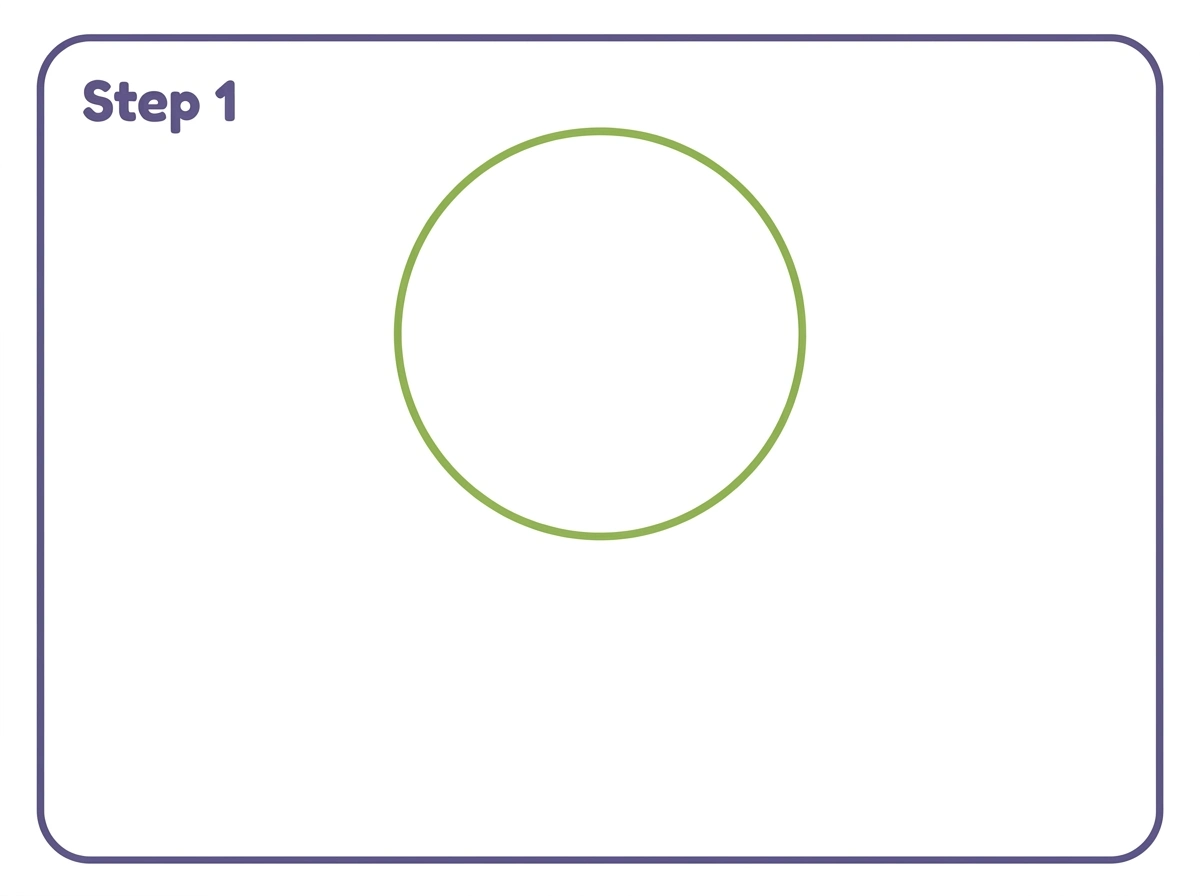
Start near the upper center of the page and draw a large round circle for the dog’s head. Draw it lightly in pencil because it is a guide shape that may need slight adjustment before you commit to the final outline. Keep it large enough that there is room for face features inside and plenty of space below for the body.
A smooth round circle works better than an oval here. Dog heads from the front view are broadly round, and starting with a genuine circle keeps the proportions balanced when the ears and body are added in the next step.
Step 2 — Add the Body and Floppy Ears
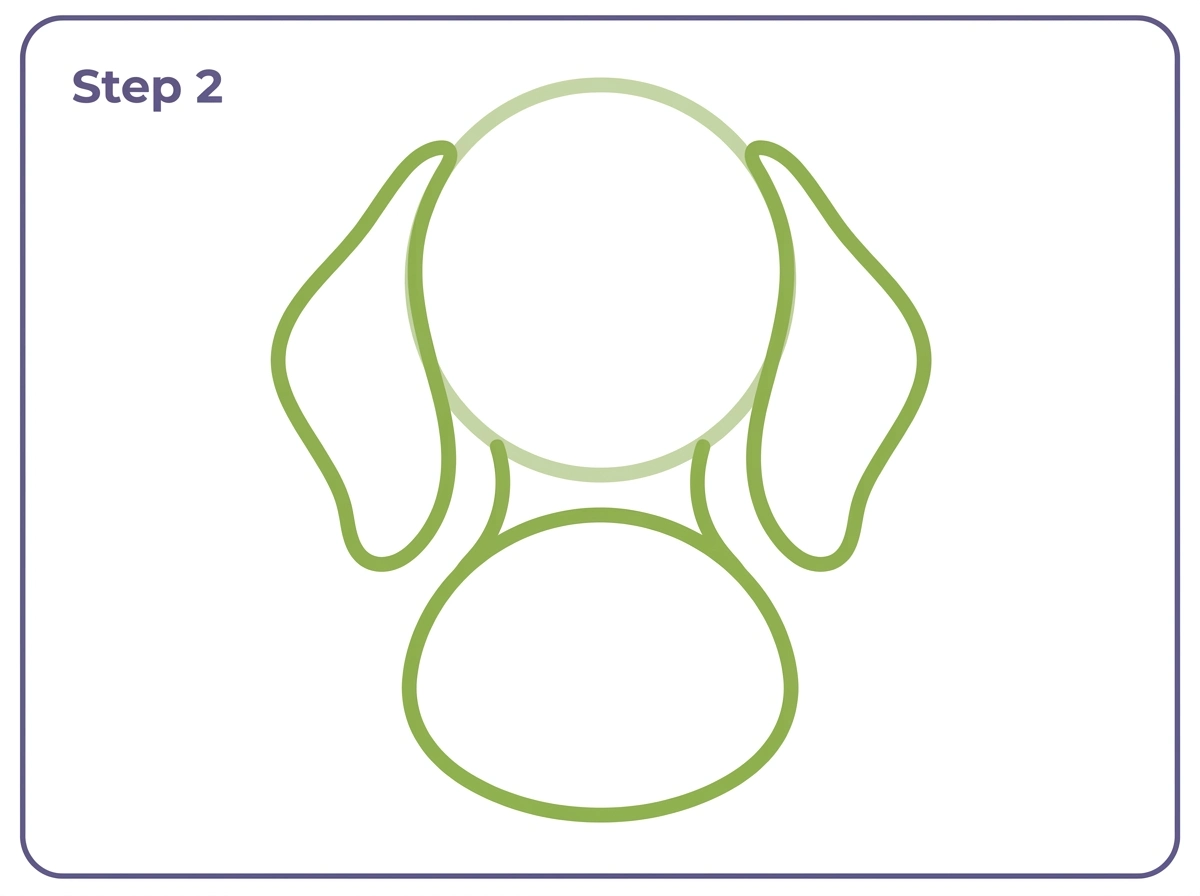
Draw a larger rounded oval body shape below the head circle. The body should be noticeably larger than the head and sit just below it, with a short gap at the neck. Connect the head and body with two short curved lines on either side for the neck.
Then add two large floppy ear shapes dropping down from either side of the head circle. Floppy ears are the most universally recognisable dog ear type because they appear on so many popular breeds, from beagles and labradors to golden retrievers and cocker spaniels. Draw each ear as a long rounded teardrop shape that hangs from the side of the head and drops below the chin level.
If you want to draw a dog with pointy ears instead, like a husky or german shepherd, replace the floppy teardrop shapes with upright triangles sitting on top of the head circle. The rest of the tutorial works exactly the same way.
Step 3 — Draw the Face Features
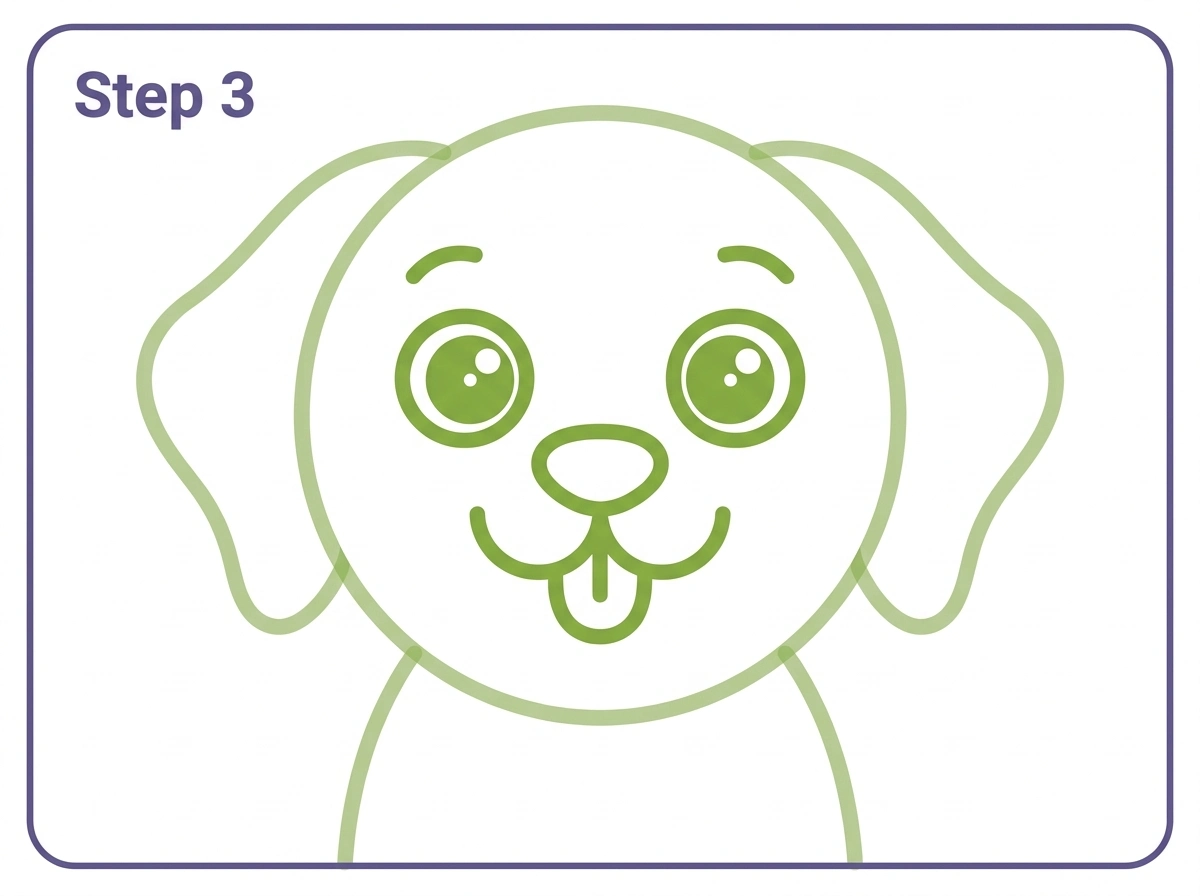
Inside the head circle, add the features that make the dog come to life. Position two large round eyes in the upper half of the face, each with a circular pupil inside and a tiny white sparkle dot in the upper left corner of each pupil. The sparkle dot is a small detail that immediately makes the eyes look bright and alive rather than flat.
Below and between the eyes, draw a rounded oval nose. Dogs have distinctly larger noses relative to face size than cats, which is one of the clearest distinguishing features between the two animals in cartoon drawing. Below the nose, draw a curved W shaped mouth with a short vertical line connecting the nose to the W. Add a small rounded tongue shape hanging below the center of the W.
Add two short curved eyebrow lines above each eye. Slight inward angle on the eyebrows gives the dog an earnest, attentive expression. The collar added at the neck, a simple band with a small circular tag hanging from the center, completes the face area and suggests a well-loved pet rather than a wild dog.
Step 4 — Add Legs, Paws and Tail
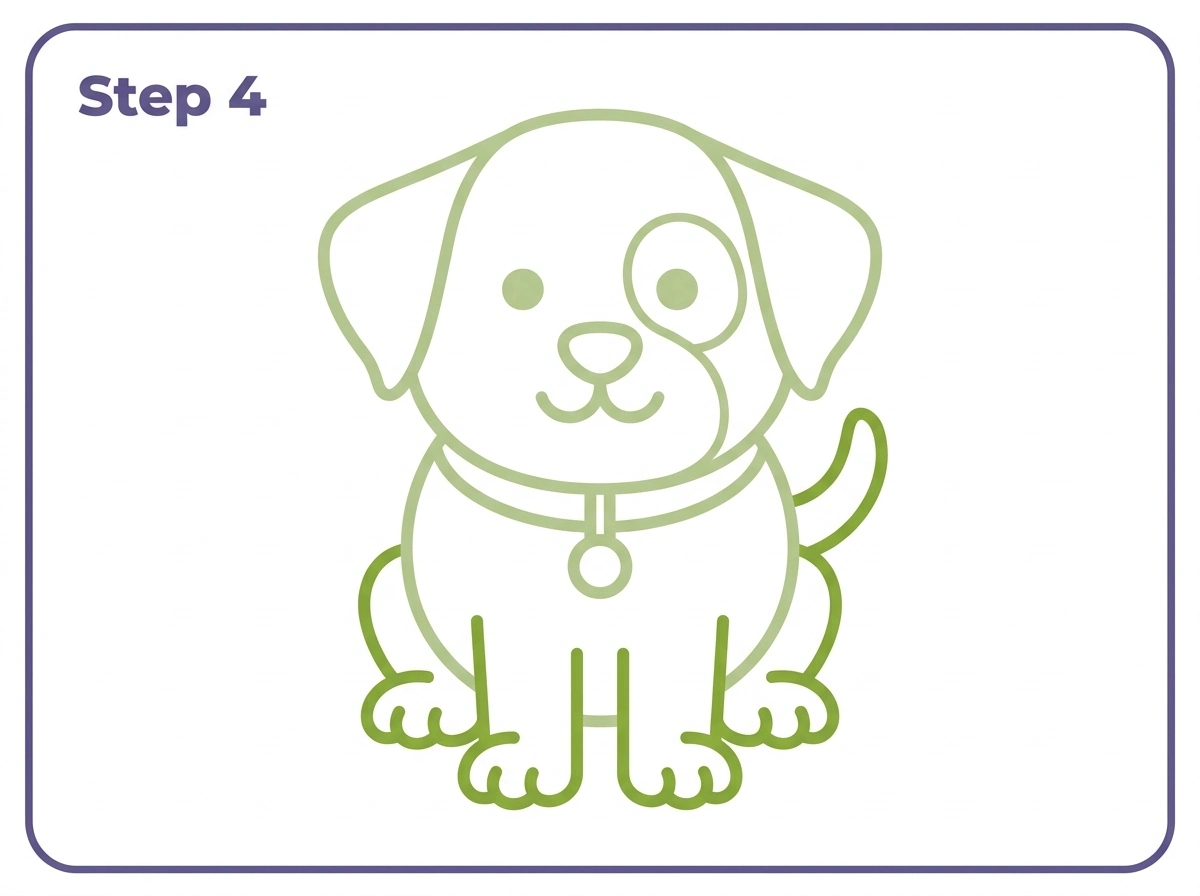
Below the body oval, add four short stubby legs. Draw two front legs side by side at the center bottom of the body, each ending in a small rounded paw with three curved toe bumps across the top. Two small back paws peek out from behind the front legs on either side, suggesting the sitting pose without requiring a complex side-view leg construction.
On the right side of the body, add a short curved tail that curls upward. A wagging tail curling up and to the side is one of the most immediate visual signals of a happy dog, and in a cartoon drawing this simple curved line carries all of that meaning.
Step 5 — Colour the Dog
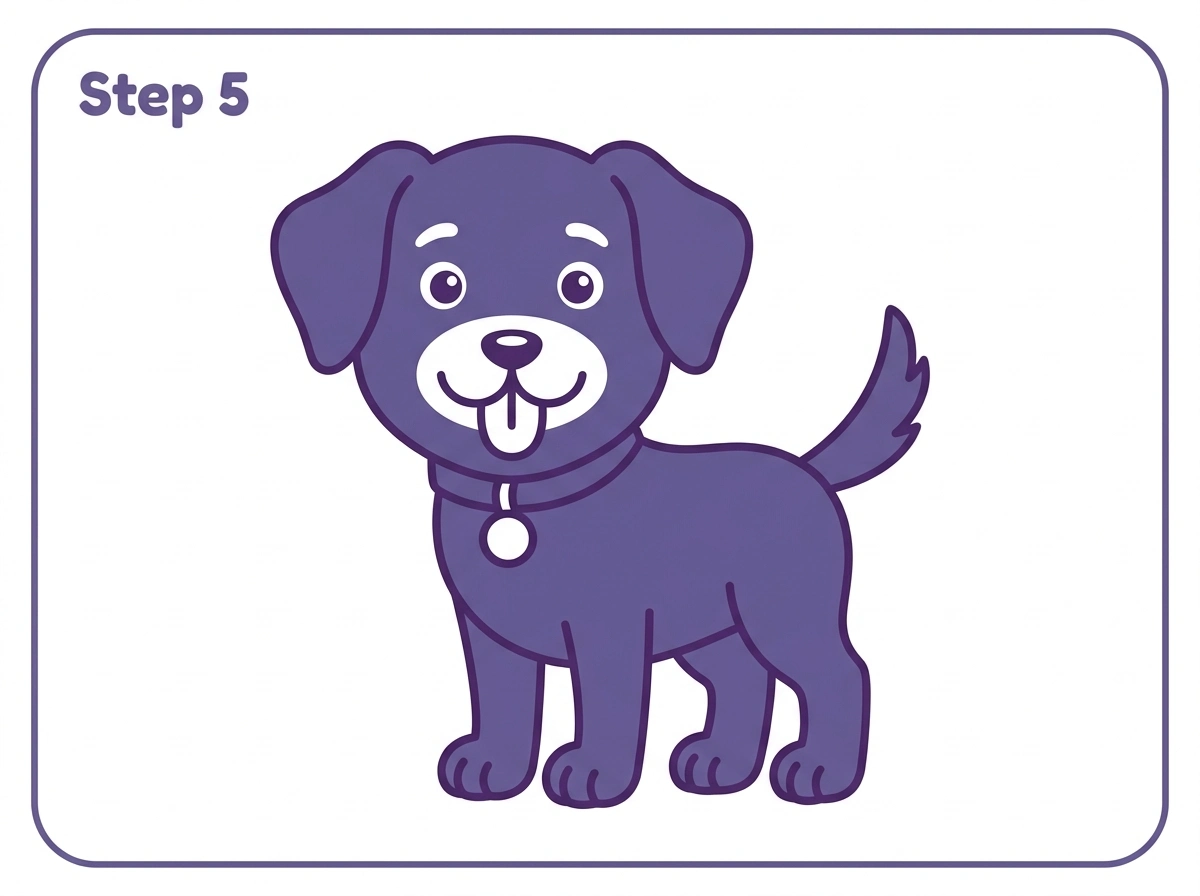
The dog is now fully drawn and ready to colour. Dogs come in more coat colour variations than almost any other animal, which gives this step a wide range of creative possibilities.
A golden retriever uses warm golden yellow throughout with a slightly paler cream on the chest and paw areas. A dalmatian uses white as the base with black spots of varying sizes scattered across the body. A chocolate labrador uses a deep warm brown. A husky combines grey and white with distinctive facial markings. A beagle uses a three-colour combination of brown, black and white.
For a simple single-colour cartoon dog, any warm colour from golden yellow to light brown to grey produces a satisfying result.
How to Draw a Dog Face
Drawing just the dog face as a standalone portrait is a popular and useful exercise. Start with the head circle. Add floppy ears on either side dropping below the chin line. Add the nose, eyes, mouth and tongue as described in Step 3, but make each feature slightly larger since the face is now filling the entire page rather than sharing space with a body.
A dog face easy enough for very young children uses dot eyes, a simple oval nose and a curved smile without the W mouth construction. Even this simplified version reads as a dog immediately when the floppy ears are in place.
For a dog face realistic enough to suggest a specific breed, the proportions change significantly. A labrador has a broader, shorter muzzle than a greyhound. A pug has an almost flat muzzle with very visible nose folds. A collie has a long narrow face with a pointed muzzle. Using reference photographs of the specific breed alongside the drawing helps capture these differences.
How to Draw a Dog Paw
A dog paw from the front view is a rounded shape with three or four toe bumps visible across the top. Draw a rounded oval as the main pad shape. Add three rounded bumps across the upper edge of the oval, evenly spaced, for the toe tips. A slightly smaller oval inside the main pad suggests the central pad visible between the toes.
A dog paw print, as opposed to the paw itself, consists of the central teardrop-shaped pad surrounded by four smaller oval toe pads arranged above it. This print shape appears on surfaces, craft projects and as a design element in dog-related artwork.
How to Draw a Dog Sitting
The five-step tutorial above produces a sitting dog. The key to a convincing sitting dog drawing is keeping the front legs straight and vertical rather than angled outward, and positioning the back paws so they are visible at the sides of the front legs rather than hidden behind them entirely.
For a more realistic sitting dog, the back legs fold under the body at the knee. The knee joint of the back leg is visible as a rounded bump at the side of the body, and the lower part of the back leg extends forward below the belly. This construction is more complex than the simplified paw approach used in this tutorial but produces a more anatomically convincing result.
How to Draw a Dog Lying Down
A dog lying down uses a horizontal orientation rather than the vertical sitting pose. Draw a long oval for the body placed horizontally across the center of the page. Add the head circle at one end, connected by a short neck. The front legs extend forward from the front of the body, shown as two short parallel horizontal lines ending in paws. The back legs tuck under the rear of the body.
A dog lying with its head resting on its front paws is one of the most charming and recognisable dog poses. Draw the front legs extending forward and then curve them gently so the paws turn inward, with the head circle resting directly on top of the folded paw area.
How to Draw a Cute Kawaii Dog
A kawaii dog uses the same construction as this tutorial but with exaggerated proportions. The head circle should be considerably larger relative to the body, about two thirds of the total height rather than one third. The eyes are very large, taking up most of the upper face, with oversized sparkle highlights. The body is very small and round, almost vestigial below the large head. The legs are tiny stubs.
Rosy circles on the cheeks, drawn as simple circles without detail, add the kawaii character quality. The overall effect is a dog that looks simultaneously like a puppy and a plush toy.
How to Draw a Realistic Dog
A realistic dog drawing moves away from the circle and oval construction toward observation of actual dog anatomy. Study the proportions of your chosen breed. Note how the head sits on the neck, how the neck angles into the shoulders, how the legs have distinct joints at the shoulder, elbow, knee and ankle, and how the paws have visible toe structure.
For a realistic dog full body drawing, start with a light skeleton sketch showing the main masses rather than the outlines. The head as a rough oval. The chest as a large rounded form. The hindquarters as a second large form behind it. The legs as simple line pairs suggesting bones rather than muscles. Then build the outline around this skeleton sketch and erase the structure lines once the final outline is in place.
Drawing a realistic dog with pencil requires attention to the direction of fur growth. Short smooth pencil strokes following the direction the fur naturally lies create a much more convincing coat texture than strokes applied randomly.
Dog Drawing Tips for Beginners
The ears are the most reliable quick way to suggest a specific breed in a cartoon dog drawing. Floppy ears read as labrador, beagle or spaniel. Upright triangular ears read as husky, german shepherd or chihuahua. Very large long ears hanging well below the chin read as basset hound or bloodhound. This means changing just the ear shape on the same basic construction produces recognisably different breeds.
The tongue is optional but worth including. A dog with a visible tongue immediately looks friendly and enthusiastic, which matches most people’s experience of dogs and makes the finished drawing more appealing.
The collar and tag are small details that transform a generic cartoon dog into a pet. Even a simple collar band with a circular tag suggests that this specific dog belongs to someone and has a name, which gives the drawing more personality.
How to Draw a Dog Bone
A dog bone is one of the simpler and more satisfying objects to draw alongside a dog illustration. Draw a horizontal rectangle in the center of the page. At each end of the rectangle, draw two small circles side by side on both the top and bottom edges, creating the characteristic double-knob ends of a cartoon bone. Smooth the connection between the rectangle and the knob circles and erase the original rectangle outline once the bone shape is established.
A dog bone easy enough for Class 1 uses simple rounded dumbbell shapes rather than the precise double-knob construction. Two large circles connected by a narrow waist line produces a recognisable bone shape in about thirty seconds.
How to Draw a Hot Dog
A hot dog drawing is a fun food illustration that connects to dog drawing through its name. Draw a large elongated oval for the bread bun. Inside the oval, draw a smaller but longer rounded cylinder for the sausage, extending slightly beyond the bun on both ends. Add a wavy zigzag line of mustard across the sausage. A thin curved line of ketchup alongside it. The bread bun can have a curved line across the top to suggest the split.
Fun Facts About Dogs for Kids
Dogs were the first animal to be domesticated by humans, a process that began somewhere between fifteen thousand and forty thousand years ago. Modern dogs are all descended from ancient wolves that began associating with human hunter-gatherer groups.
There are over three hundred recognised dog breeds worldwide, ranging from the tiny Chihuahua, which weighs about two kilograms, to the Great Dane, which can weigh over seventy kilograms.
Dogs can smell approximately ten thousand to one hundred thousand times better than humans. This extraordinary sense of smell is why dogs are trained for search and rescue, medical detection and customs inspection.
A dog’s nose print is unique, in the same way that human fingerprints are unique. No two dogs have the same pattern of ridges and creases on their nose pad.
Dogs dream. Studies of sleeping dogs show the same brain wave patterns seen in dreaming humans, and dogs often twitch, whimper or move their legs during sleep in ways consistent with dreaming about activities from their waking day.
Printable Dog Outline PDF
A printable dog outline based on the finished Step 5 design is available as a free download below. Print it on plain white paper and use it as a colouring page, as a reference guide when working through the drawing steps, or as a template for craft projects. The outline includes all the completed line details from the tutorial so it works as a standalone colouring sheet even without completing the drawing tutorial first.
Explore Related Free Printable Coloring Collections
Looking for more engaging activities? Check out these free printable coloring pages fun for kids, useful for teachers, relaxing for adults, and inspiring for designers.